
UNDERSTAND THE SCIENCE
Living cells can influence the biological conversation around injury and repair.
MSCs are studied for their ability to interact with immune cells and release signals that influence surrounding tissues. Understanding that activity reveals why this field is compelling and why cell identity, preparation and clinical context deserve a detailed explanation.
01 · Patient overview
Think of tissue repair as a coordinated conversation. Immune cells respond to injury, blood vessels supply the tissue, and local cells maintain or rebuild its structure. MSC research explores how a therapeutic cell population can participate in that conversation.
The familiar phrase mesenchymal stem cells is widely used. In scientific reporting, mesenchymal stromal cells is often the more accurate name for an expanded population unless stem-cell properties have been demonstrated rigorously. This is a distinction about biological identity, not a dismissal of therapeutic potential. ISCT position statement on MSC nomenclature
For patients, the key idea is simple: the interest in MSCs extends beyond the possibility of forming tissue. Their interactions with other cells are central to the therapeutic questions researchers are investigating.
02 · The science in depth
The classic ISCT criteria describe cells that adhere to plastic under standard culture conditions, express CD73, CD90 and CD105, and lack specified blood-cell and immune markers. They also demonstrate bone, fat and cartilage differentiation in laboratory conditions. These criteria established a common vocabulary for research. Dominici et al. (2006). ISCT minimum criteria for MSC identity. Cytotherapy.
A marker panel is an identity check, not a clinical performance score. Two preparations can satisfy the same minimum definition while differing in growth history, donor characteristics and functional activity. A report becomes more informative when it identifies the tissue source and explains how the cells were characterized.
This distinction also separates expanded MSC populations from mixed preparations such as SVF or bone marrow concentrate. The source tissue may be related, but the composition and preparation process are different.
| Question | What it tells you |
|---|---|
| Identity | Which population is present and where it came from. |
| Quality | Whether relevant release specifications were met, including viability and contamination testing. |
| Function | Which biological activity has been measured and how it relates to the intended use. |
MSCs are not biologically static. In experimental systems, inflammatory signals can alter their immune-regulating activity, a process often called licensing. That makes the surrounding environment part of the mechanism rather than a passive background.
Ren and colleagues demonstrated an instructive species difference: human MSC-mediated immune suppression relied on indoleamine 2,3-dioxygenase, or IDO, whereas mouse MSCs used nitric oxide under the tested conditions. Inflammatory stimulation was important to the response. This illustrates both the sophistication of MSC biology and the need to interpret animal findings carefully. Ren et al. (2009). Species variation in MSC-mediated immunosuppression. Stem Cells.
IDO participates in tryptophan metabolism. In this setting, changes in the local metabolic environment can influence immune-cell behavior. A mechanism such as this helps explain why an MSC treatment is investigated as a responsive biological intervention rather than simply as replacement tissue.
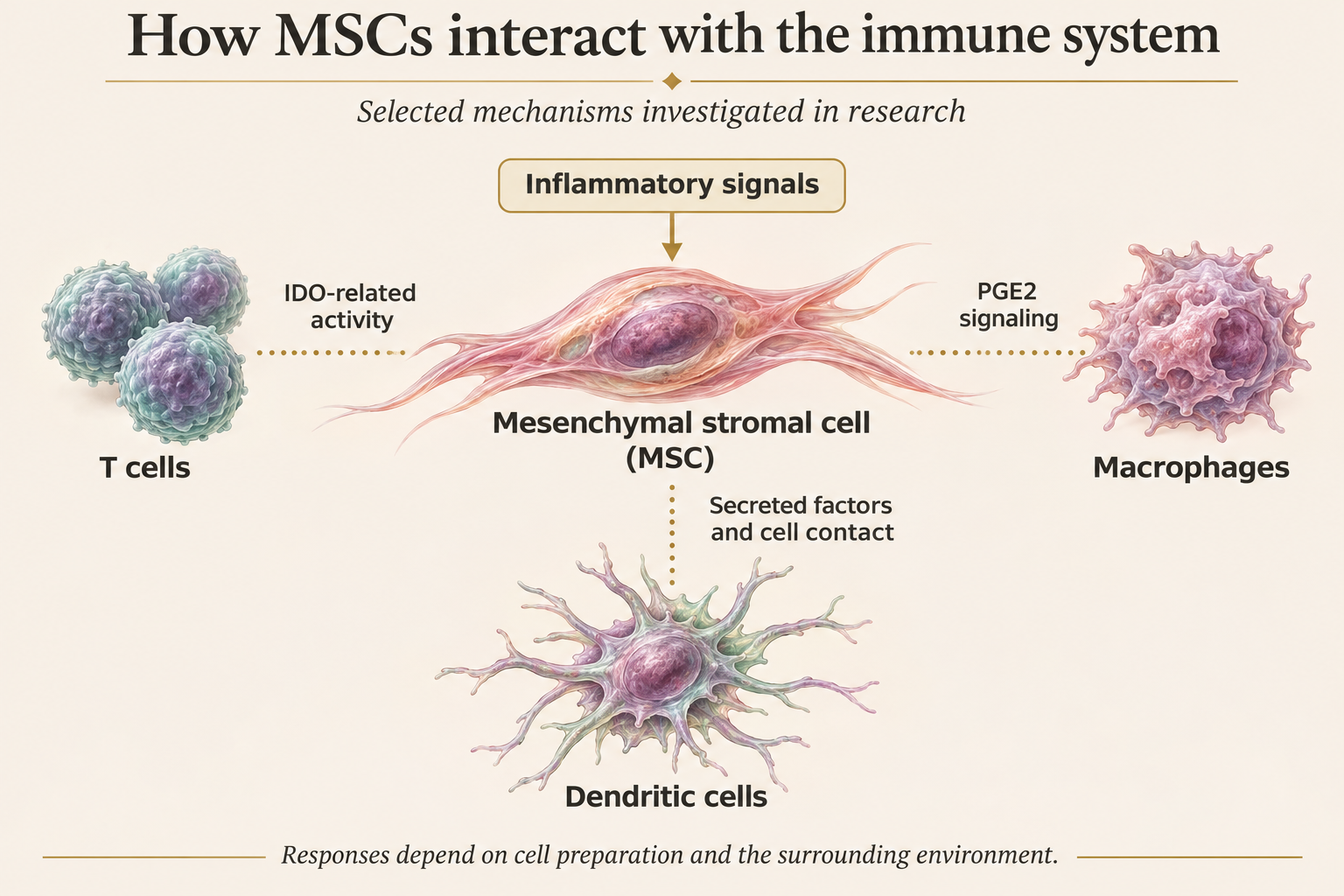
Illustration of an MSC receiving inflammatory signals and interacting with T cells, macrophages and dendritic cells through selected research mechanisms.
Paracrine activity means a cell influences other nearby cells through released signals. Soluble factors and extracellular vesicles are investigated as parts of this communication. Cell contact and the response of the recipient’s immune system can also contribute.
A particularly important study by Galleu and colleagues showed that recipient-induced MSC apoptosis, followed by uptake by phagocytes, could contribute to immune modulation in the studied graft-versus-host disease setting. The finding challenged the assumption that prolonged survival of administered cells must be required for biological activity. Galleu et al. (2017). Recipient-mediated immunomodulation following MSC apoptosis. Science Translational Medicine.
Apoptosis is an organized cell-death process. Phagocytes are cells that engulf cellular material. The scientific lesson is that the recipient is an active participant in the mechanism. This does not establish the same pathway for every indication, but it expands the questions that a sophisticated MSC explanation should address.
A viable-cell count answers how many cells are alive at the time of measurement. It does not establish what those cells can do. Potency testing addresses biological activity relevant to the intended therapeutic purpose.
The ISCT has discussed a matrix approach using complementary measurements such as selected gene expression, functionally relevant surface markers and secreted proteins. No single universal marker is sufficient for every clinical application. An immune-directed application and a tissue-repair application may require different functional questions. Galipeau et al. (2016). ISCT perspective on immune functional potency assays. Cytotherapy.
For a clinician or researcher, this is where characterization becomes especially important. Source, culture history, storage and delivery should be considered alongside the intended mechanism. For a patient, the practical question is whether the proposed preparation has a clear identity and a defensible scientific rationale.
Identity asks what the preparation is. Potency asks whether it performs a relevant biological function in a defined assay. Efficacy asks whether it produces the intended clinical benefit in people. A strong technical account treats these as connected but separate levels of evidence.
An immune-function assay might measure a response of a selected immune-cell population under specified conditions. That result needs a reproducible method and a rationale linking it to the intended mechanism. It is not itself a measurement of walking ability, joint pain or independence. Galipeau et al. (2016). ISCT perspective on immune functional potency assays. Cytotherapy.
This distinction explains why a high cell count or an impressive marker panel cannot substitute for clinical evidence. It also explains why a positive clinical trial does not eliminate the need for consistent preparation. Scientific credibility depends on the bridge between the material, the measured activity and the patient outcome.
An early randomized knee osteoarthritis study by Lee and colleagues compared expanded autologous adipose MSCs with saline in 24 participants. The MSC group improved on the WOMAC symptom and function measure at six months. The small study supports continued investigation of that preparation and setting. Lee et al. (2019). Phase IIb placebo-controlled trial of expanded adipose MSCs in knee osteoarthritis. Stem Cells Translational Medicine.
This is a more useful statement than saying MSCs regenerate every joint. Human research is organized around a defined population, route, comparator and endpoint. The osteoarthritis and stroke guides examine these clinical questions in their respective disease settings.
A clinical research program advances by connecting reproducible preparation with reproducible outcomes. Promising biology is the starting point; a clearly measured improvement gives that biology practical significance.
03 · Your practical guide
At Sure Health 360 Center for Regenerative Medicine and Cell Therapy, the discussion begins with your condition and goals. Ask which preparation is proposed, whether it is autologous or donor-derived, how it would be administered and which human evidence relates to the intended use.
Your medical history, organ function, medicines and current care help determine whether a proposed intervention fits your broader plan. The explanation should include preparation, recovery arrangements, relevant risks and alternatives, as well as how benefit would be assessed.
Bring available medical records and a short list of functional priorities. A useful follow-up plan identifies what will be measured and when. The aim is a scientifically informed decision you can understand, with progress defined in terms that matter in daily life.
No. Tissue source, processing, composition and functional characteristics can differ. The evidence should relate to the proposed preparation and application.
No. Exosomes are a type of extracellular vesicle. They require their own explanation and evidence, separate from studies of living-cell therapies.
Cell number alone does not establish clinical benefit. The preparation, viability, functional activity, delivery and relevant research also matter.
Explore what this science could mean for you.
Bring your questions to Sure Health 360 Center for Regenerative Medicine and Cell Therapy. Consult in Davao City or begin with a teleconsultation. Appointments are confirmed by phone or email.
Request a consultationExplore all 14 services · Explore all care pathways · Meet your physician and clinic
The publications below report external research. They do not represent outcomes measured at our clinic.