
Care by Condition / NeuroRegen
Scientific exploration with memory, daily participation, and family life at its centre.
Discuss your careMemory changes can alter familiar routines, conversations, and the balance of responsibilities within a family. For the person experiencing them, maintaining dignity, connection, and participation matters as much as any test score.
Regenerative medicine is exploring processes involved in Alzheimer’s disease, including inflammatory and vascular factors. At Sure Health 360 Center for Regenerative Medicine and Cell Therapy, a consultation begins with the diagnosis, stage, current care, and the observations of the person and those supporting them. The purpose is to understand whether a specific treatment discussion is relevant, and what a meaningful goal would be.
Alzheimer’s disease involves changes in proteins, synapses, neurons, and supporting tissue. Amyloid and tau pathology are important parts of its biology, but cognition also depends on functioning networks and their surrounding environment. Neuroinflammation and vascular health are among the areas being investigated in cellular research. [AD]
Memory impairment is not a diagnosis by itself, and not all dementia is Alzheimer’s disease. Medication effects, mood, sleep, hearing, vascular disease, and other neurological conditions may contribute to a person’s difficulties. Establishing the clinical picture is more useful than assuming every memory concern has the same biological target.
MSC-based approaches investigate whether cell signaling and immune interactions can influence a disease environment. This is different from transplanting a ready-made memory circuit. The question is whether a defined preparation can affect processes associated with decline and whether those effects translate into cognitive or functional outcomes.
Research must connect biological measurements with clinical findings. Brain volume, an inflammatory imaging measure, a cognitive score, and the ability to manage daily activities are related but distinct. A favorable change in one should not be described as restoration of the whole brain.
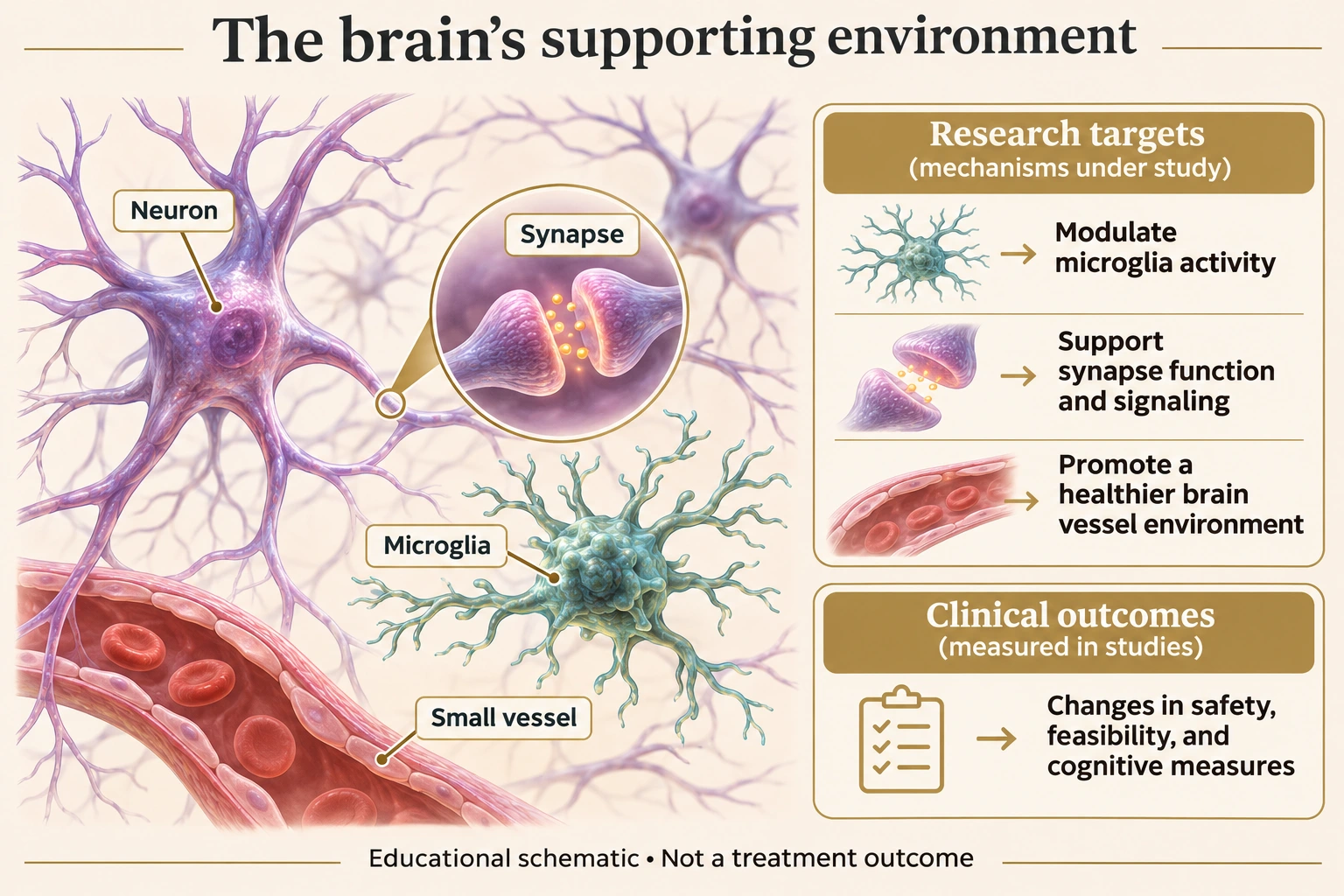
Neurons, synapses, immune cells and blood vessels interact within the brain environment. These are research targets, not evidence of restored brain tissue after treatment.
The 2025 CLEAR-MIND phase 2a trial studied laromestrocel, an allogeneic bone-marrow MSC product, in 49 participants with mild Alzheimer’s disease. It met its primary safety endpoint and reported encouraging clinical and imaging findings over 39 weeks, including less brain-volume decline in treated groups. [AD]
The study is a reason for continued investigation, not a forecast of an individual response. Small treatment groups, multiple analyses, product identity, and the mild-disease population matter. A relative reduction in volume decline should not be rewritten as a percentage of memory recovered or disease reversed. Larger trials are needed to clarify clinical benefit and durability. [AD]
For a patient, the central question is whether a proposed treatment has a credible prospect of affecting a goal that matters, and how that would be assessed. Maintaining participation in familiar routines or supporting daily function may be priorities. These are goals for discussion, not promised outcomes of cellular treatment.
The consultation should identify the preparation actually being offered and explain whether the cited study used the same product, route, and population. The name of an external investigational product should not imply it is available at the clinic. A clear comparison makes the research more useful.
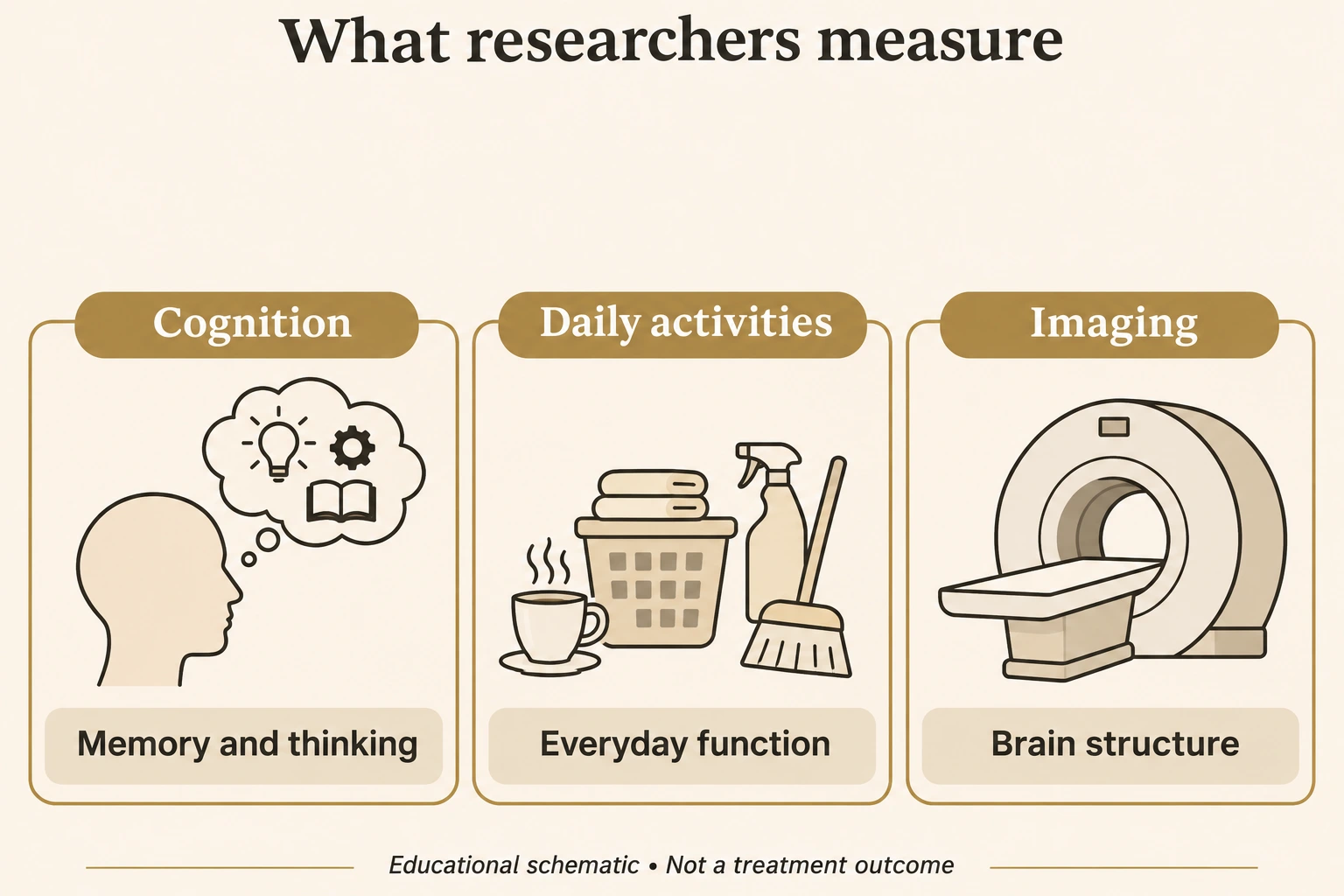
Cognition, daily activities and imaging measure different aspects of Alzheimer’s disease. A change in one measure does not automatically establish benefit in another.
At Sure Health 360 Center for Regenerative Medicine and Cell Therapy, assessment considers medicines, cognition, function, general health, and care at home. With the patient’s agreement and appropriate support for decision-making, a family member can describe changes over time.
Continuing neurological care, suitable established treatments, activity, nutrition, sleep, hearing support, and caregiver resources remain important. Treatment discussions should include the person’s preferences, capacity to participate, the demands of travel and follow-up, and the alternatives. A worthwhile plan must be practical for the person who will receive it.
Bring diagnostic reports, available cognitive assessments, imaging, medication and supplement lists, and a brief description of daily abilities. Note changes in medication management, finances, cooking, navigation, sleep, or personal care. Tell the team about falls, weight loss, swallowing concerns, and any sudden change rather than assuming everything is gradual progression.
Follow-up should use consistent measures and record changes in care as well as symptoms. A familiar observer’s account is useful, but should complement structured assessment. The plan should identify when the treating team will reassess the value and burden of an intervention.
Does this research apply to advanced dementia? The cited trial studied mild Alzheimer’s disease. Its findings should not be generalized to every stage.
Could treatment restore lost memories? That has not been established by this study. Discuss the actual outcomes evaluated and the individual’s priorities.
Can a family member join? Yes, with appropriate agreement and support for the patient. A teleconsultation may begin the discussion before travel; appointments are confirmed by phone or email.