
Care by Condition / NeuroRegen
Exploring recovery through the biology of injury, surviving networks, and rehabilitation.
Discuss your careA traumatic brain injury can change movement, attention, memory, communication, sleep, and the ability to manage work or family responsibilities. Some difficulties are visible; others become apparent only during demanding daily tasks. Recovery needs to account for both.
Cellular medicine is investigating whether particular interventions can help improve function after brain injury. At Sure Health 360 Center for Regenerative Medicine and Cell Therapy, the starting point is the injury history, present difficulties, rehabilitation, and the activities you want to regain. A treatment discussion should be as specific as the challenges you face.
Traumatic injury can produce focal damage and more diffuse disruption of connections. Its effects depend on where the injury occurred, which networks were affected, and the complications that followed. Persistent weakness is a different clinical problem from impaired attention, chronic headache, or difficulty regulating sleep and mood.
The brain’s ability to adapt creates a basis for rehabilitation. Repeated, purposeful activity can help train available networks and compensatory strategies. A proposed biological treatment must be considered within that functional setting. An anatomical image alone cannot describe everything a person can or cannot do.
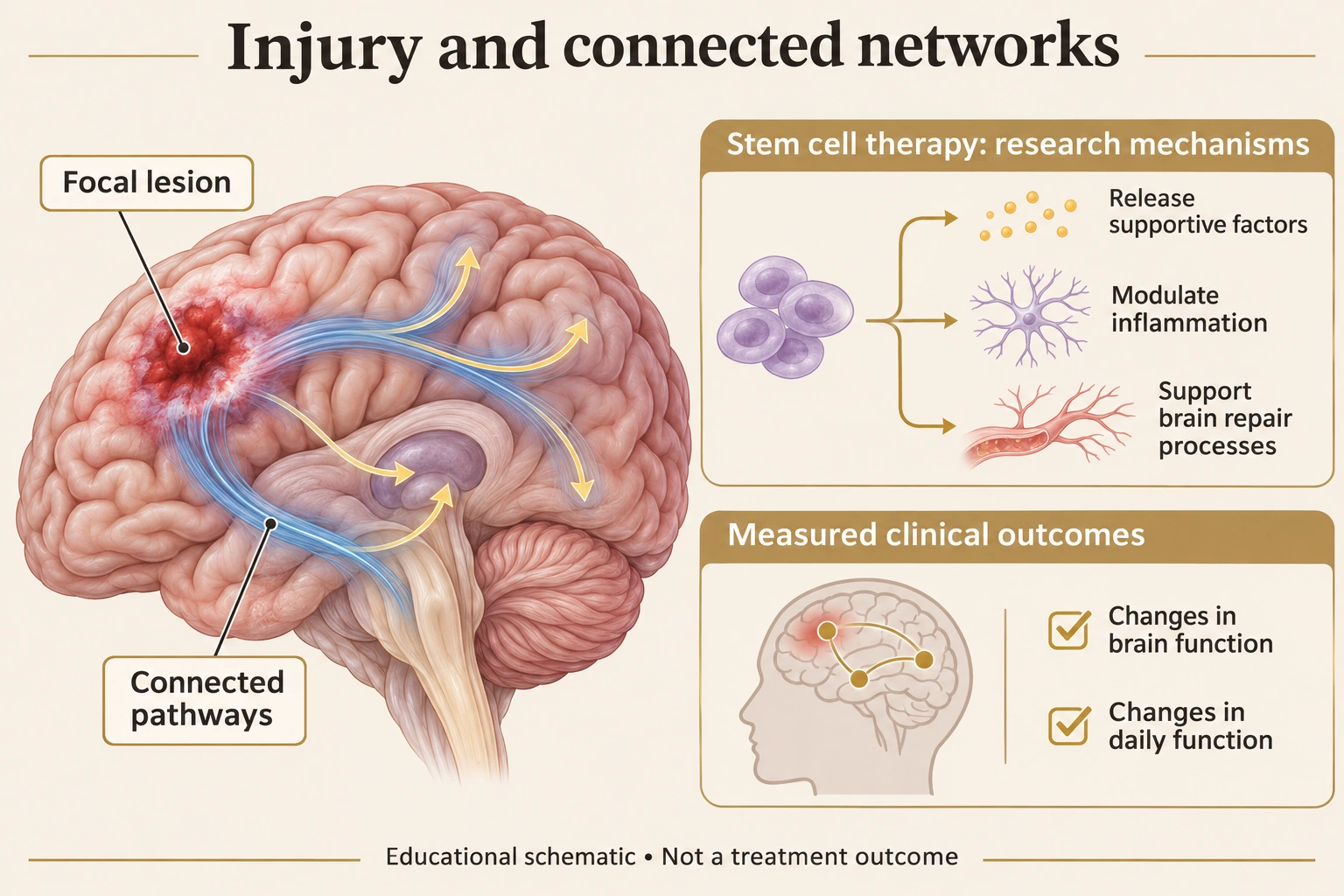
Traumatic brain injury may involve focal damage and distributed network disruption. This schematic represents a concept, not a universal pattern of injury.
Some approaches investigate trophic and immune signaling around injured tissue. Others place a defined cellular product directly near a lesion. These are not interchangeable strategies. Route changes where a preparation is delivered, the procedure required, and the risks that must be considered.
An especially important distinction is between acute injury and stable chronic deficits. During the acute phase, clinicians prioritize stabilization and complications. A study involving persistent motor deficits months or years later cannot be assumed to apply to emergency treatment or every form of concussion.
STEMTRA evaluated SB623, a modified donor bone-marrow stromal-cell product implanted surgically into the brain. The randomized sham-controlled phase 2 trial assessed 61 participants who underwent a procedure and had chronic motor deficits after TBI. At six months, the treated group improved more on the Fugl-Meyer motor scale than the control group, meeting the primary efficacy endpoint. Secondary outcomes did not show statistically significant differences at that time. [TBI]
This is encouraging evidence that a defined intervention can affect a specific chronic motor outcome. It is not evidence that intravenous MSCs, exosomes, or another preparation will reproduce the result. Surgical delivery and product modification are integral to the finding. A subsequent post hoc analysis adds follow-up and exploratory interpretation but is not a second independent randomized trial. [TBI2]
A change in a motor score may be important without restoring every daily ability. Its significance depends on whether it translates into reaching, transferring, walking, or another task. Cognitive and behavioral symptoms require their own assessment and should not be treated as proven beneficiaries of a motor-focused study.
The most useful explanation connects the problem being addressed, the intervention studied, and the outcome measured. When these do not align, a dramatic headline can create an expectation that the underlying study did not test. The possibility of progress deserves a more specific account.
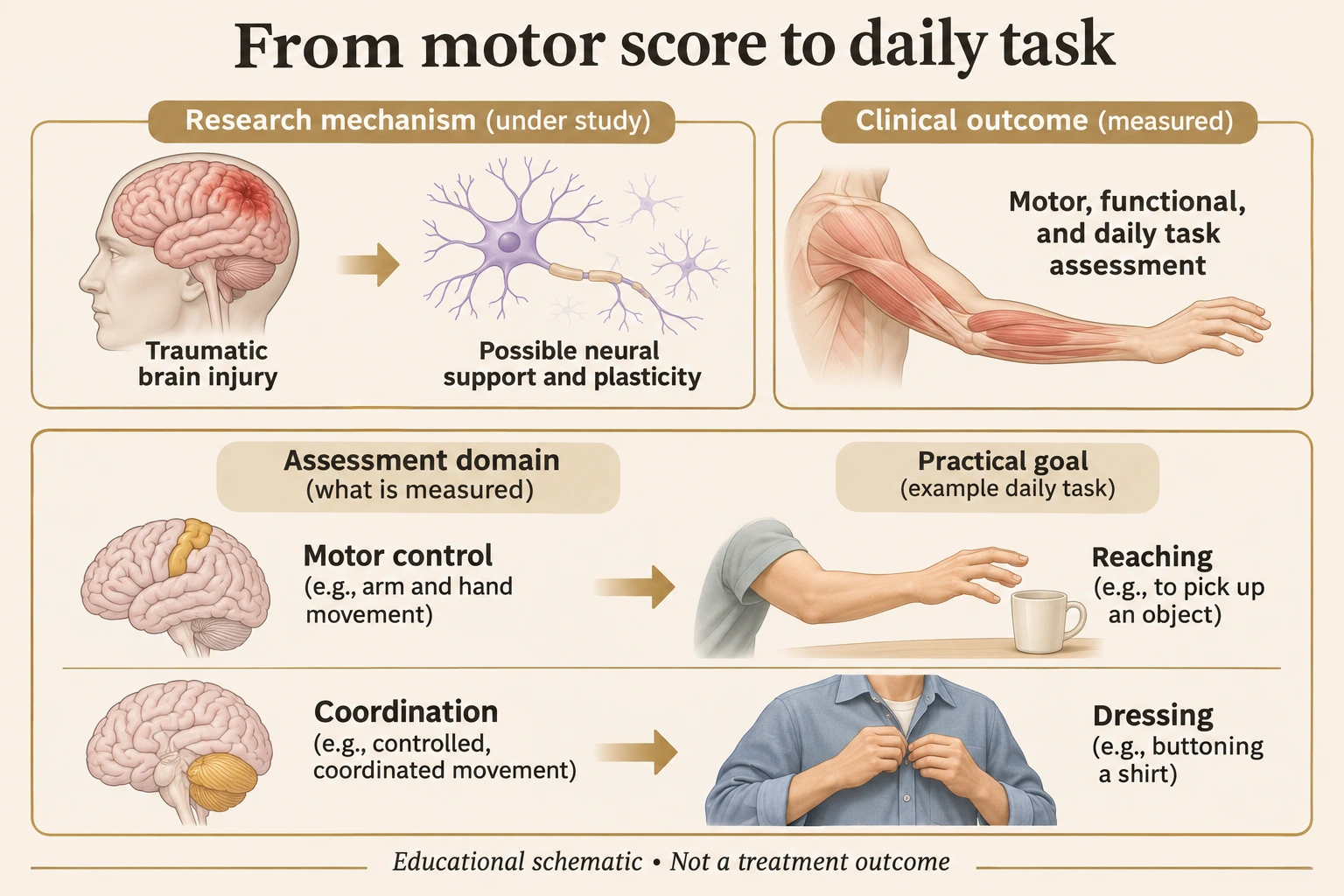
Motor examination and practical activities provide complementary views of function. The examples are assessment goals, not predicted treatment results.
At Sure Health 360 Center for Regenerative Medicine and Cell Therapy, assessment considers the injury, available imaging, seizures, medications, sleep, pain, and ongoing rehabilitation. We discuss the relevance of an available regenerative approach to that complete picture. External neurosurgical research is not an assumed clinic procedure.
Physiotherapy, occupational therapy, communication therapy, neuropsychological assessment, and management of mood or sleep may remain central to progress. The plan should identify which clinicians are involved and which outcome each component is intended to support. If a procedure is considered, its preparation, route, alternatives, and monitoring should be explained.
Bring the hospital discharge summary, surgery history, imaging reports, seizure history, medication list, and recent rehabilitation assessments. A short timeline of changes is often more useful than a large collection of unorganized reports. Include what has improved, what has remained difficult, and what makes symptoms worse.
Select functional goals before treatment decisions are made. Examples include using the affected arm during dressing, managing a household task, or sustaining participation in rehabilitation. Follow-up should distinguish strength, coordination, cognition, fatigue, and independence rather than compressing them into a single success label.
Does a study of motor recovery prove memory improvement? No. Each outcome needs its own evidence and assessment.
Can this replace rehabilitation? A biological intervention does not replace the practice and support involved in functional recovery.
Where do I begin? Arrange a consultation in Davao City or a teleconsultation. Appointments are confirmed by phone or email.