
Care by Condition / DiabCare
Exploring metabolic biology while keeping long-term health and everyday function in focus.
Discuss your careType 2 diabetes involves ongoing choices about medicines, food, activity, and monitoring. Over time, concerns may extend to the heart, kidneys, nerves, eyes, and the ability to stay active. A useful treatment discussion considers that wider picture.
Cellular research is examining processes related to insulin action and beta-cell function. At Sure Health 360 Center for Regenerative Medicine and Cell Therapy, the starting point is your treatment history, current glucose management, associated conditions, and goals. Regenerative options should have a defined purpose within that assessment.
Insulin helps regulate glucose handling across tissues, including muscle, liver, and adipose tissue. In type 2 diabetes, reduced insulin responsiveness and insufficient compensatory insulin secretion interact. The balance differs among people and changes over time.
The resulting clinical picture cannot be described by body weight alone. Duration of diabetes, pancreatic reserve, medication, muscle function, liver health, and other conditions influence management. A biological therapy directed toward one process should not be assumed to address all of them.
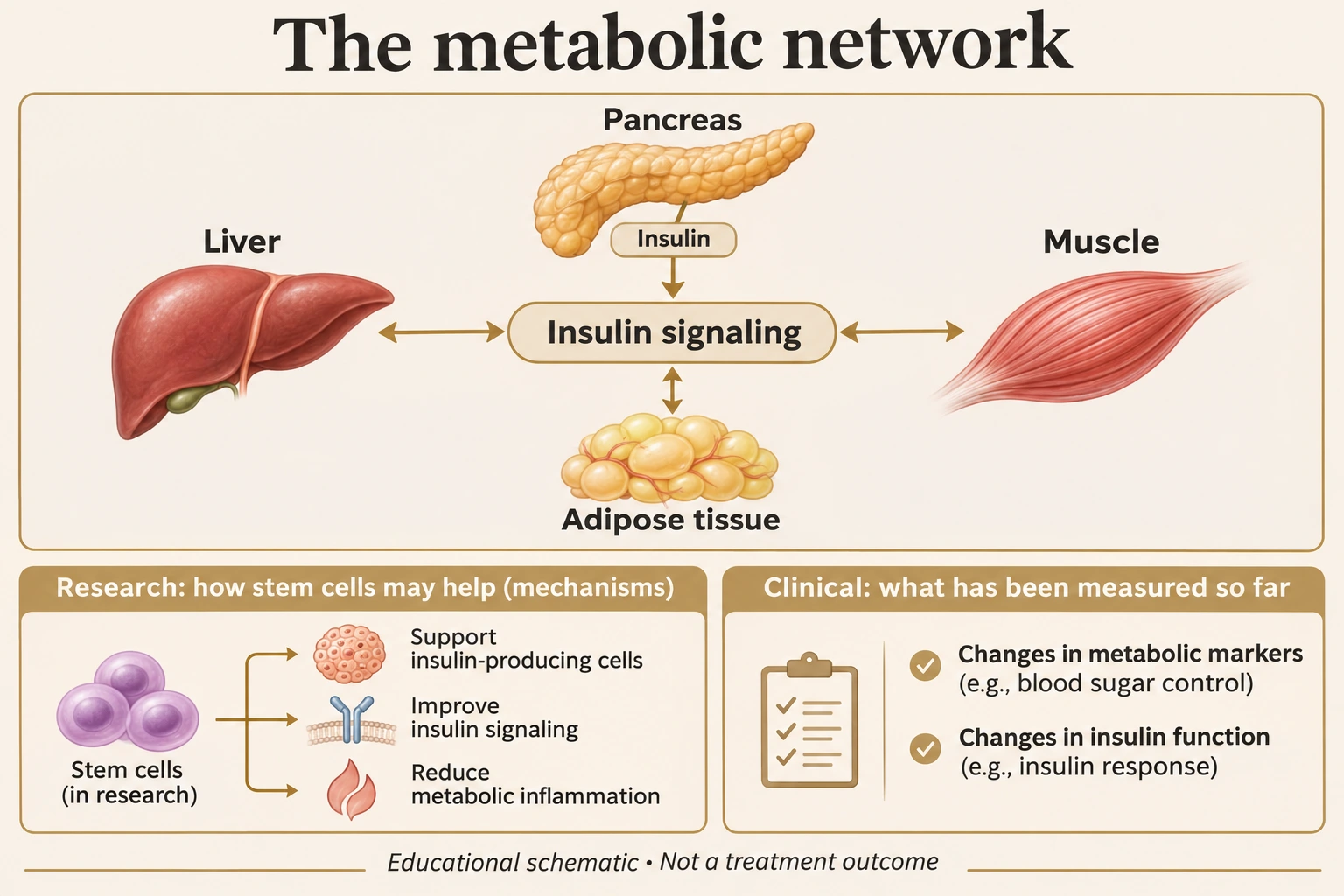
Glucose regulation involves pancreatic insulin secretion, liver glucose production and responses in muscle and adipose tissue. Type 2 diabetes affects this connected system.
UC-MSC research explores whether biological signaling can influence metabolic function. A clinical study must then establish whether that activity produces meaningful changes in glucose management or treatment requirements. This approach is distinct from replacing beta cells with a manufactured islet product. [T2]
The distinction between mechanism and outcome is especially important in diabetes. A change in an inflammatory marker does not prove restored insulin sensitivity, and reduced insulin use does not automatically mean the underlying disease has resolved. Medication adjustment, food intake, weight, and activity can affect the same outcomes.
A randomized phase II study enrolled 91 adults and compared three intravenous UC-MSC administrations with placebo over 48 weeks. It investigated a defined preparation in a specific population, providing a controlled framework for assessing glucose control and insulin requirements. The publication is useful for examining participant selection, the prespecified outcome, and how medication changes were managed. [T2]
A related randomized study report used continuous glucose monitoring to assess outcomes in 73 participants. This adds the question of how glucose behaves across the day, beyond an average HbA1c value. It should not be treated as proof that all UC-MSC products work, or counted as an independent replication without checking cohort overlap. [T2CGM]
The clinically useful promise is a possible contribution to metabolic management that can be tested with objective measures. Durable remission, prevention of complications, and freedom from medication require their own evidence and follow-up; they should not be inferred from a short-term change.
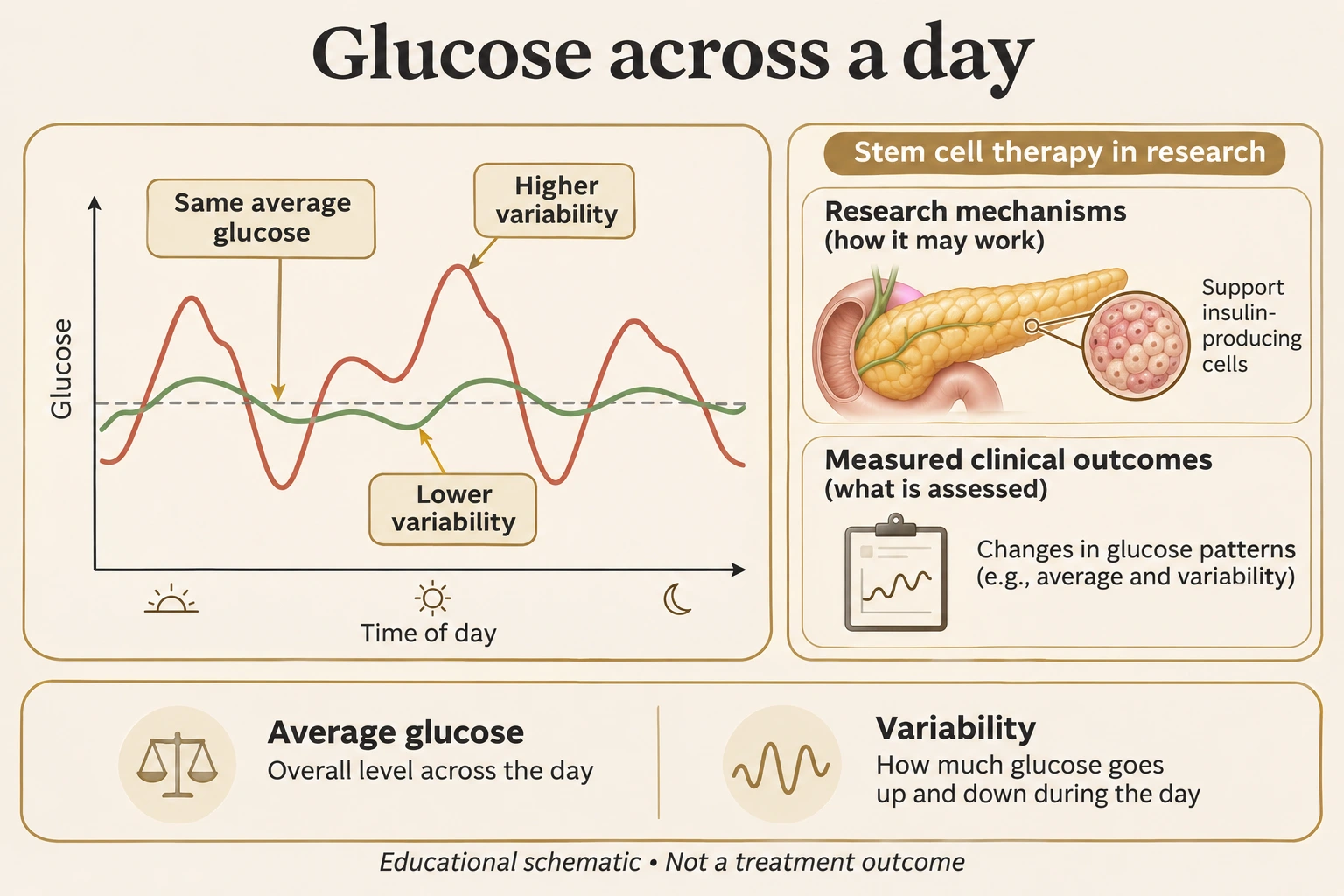
Average glucose, variation and time in range describe different aspects of glucose management. The illustration is conceptual and contains no patient data.
At Sure Health 360 Center for Regenerative Medicine and Cell Therapy, assessment considers current medicines, HbA1c and glucose patterns, kidney and cardiovascular health, nutrition, activity, and muscle function. Medical weight management and other established measures may be relevant independently of a cellular treatment.
If a regenerative intervention is proposed, the physician should explain its specific purpose and how it fits with diabetes care. A plan that changes several treatments simultaneously should also explain how progress will be interpreted. Continuing medication and monitoring should be adjusted only with the treating team.
Bring recent and earlier HbA1c results, glucose or sensor records, medication doses, kidney tests, and information about previous treatment. Note episodes of hypoglycemia, neuropathic symptoms, foot problems, weight changes, and the practical difficulties of following your current plan.
Agree on a baseline and follow-up measures. HbA1c, time in range, hypoglycemia, medication requirements, weight, and function provide different information. For someone concerned about weakness, preserving muscle and activity may be as important as reducing body weight. For someone with kidney disease, renal protection remains a major part of care.
Is this the same research as stem-cell-derived islets for type 1 diabetes? No. The biology and intervention differ, and evidence should not be transferred between them.
Can I reduce my medicines after treatment? Only with review of glucose data and the treating clinician’s advice. An infusion alone is not a reason to stop treatment.
What is the next step? Arrange a consultation in Davao City or a teleconsultation, confirmed by phone or email, to review the evidence against your health profile.