
MOVEMENT AND HEALTHY AGEING
The scientific opportunity is better movement, grounded in the biology of the whole joint.
Osteoarthritis can make everyday movement increasingly difficult. Stem cell and regenerative research is investigating ways to improve pain and function by addressing the joint environment. A strong treatment discussion connects this science with your symptoms, joint findings and the activities you want to regain.
01 · Patient overview
Walking with family, climbing stairs, sleeping comfortably and staying active are meaningful therapeutic goals. Osteoarthritis care should begin with the activities that have become difficult and the factors limiting them.
Regenerative approaches are attracting attention because the joint is biologically active. Inflammation, tissue maintenance and mechanical loading interact. Cellular treatments are being studied within that environment, with results that need to be interpreted for the specific preparation and joint condition.
Your consultation at Sure Health 360 Center for Regenerative Medicine and Cell Therapy connects these possibilities with examination, available imaging, previous treatment and your wider health.
02 · The science in depth
Articular cartilage provides a smooth bearing surface, but it is only one part of the joint. The synovium, subchondral bone, menisci, ligaments and surrounding muscles contribute to joint function and symptoms. A useful explanation therefore goes beyond the image of cartilage simply wearing away.
Inflammatory activity is relevant to this picture. In the MOST study, contrast-enhanced MRI findings of synovitis were associated with knee pain severity. This supports attention to the joint environment, while an association alone does not prove that a particular treatment will resolve pain. Baker et al. (2010). Contrast-enhanced MRI synovitis and knee pain in MOST. Annals of the Rheumatic Diseases.
Clinical assessment considers both structure and function. Imaging can characterize change, while symptoms, strength, stability and movement reveal how that change affects the person. Two patients with similar images may have different practical needs.
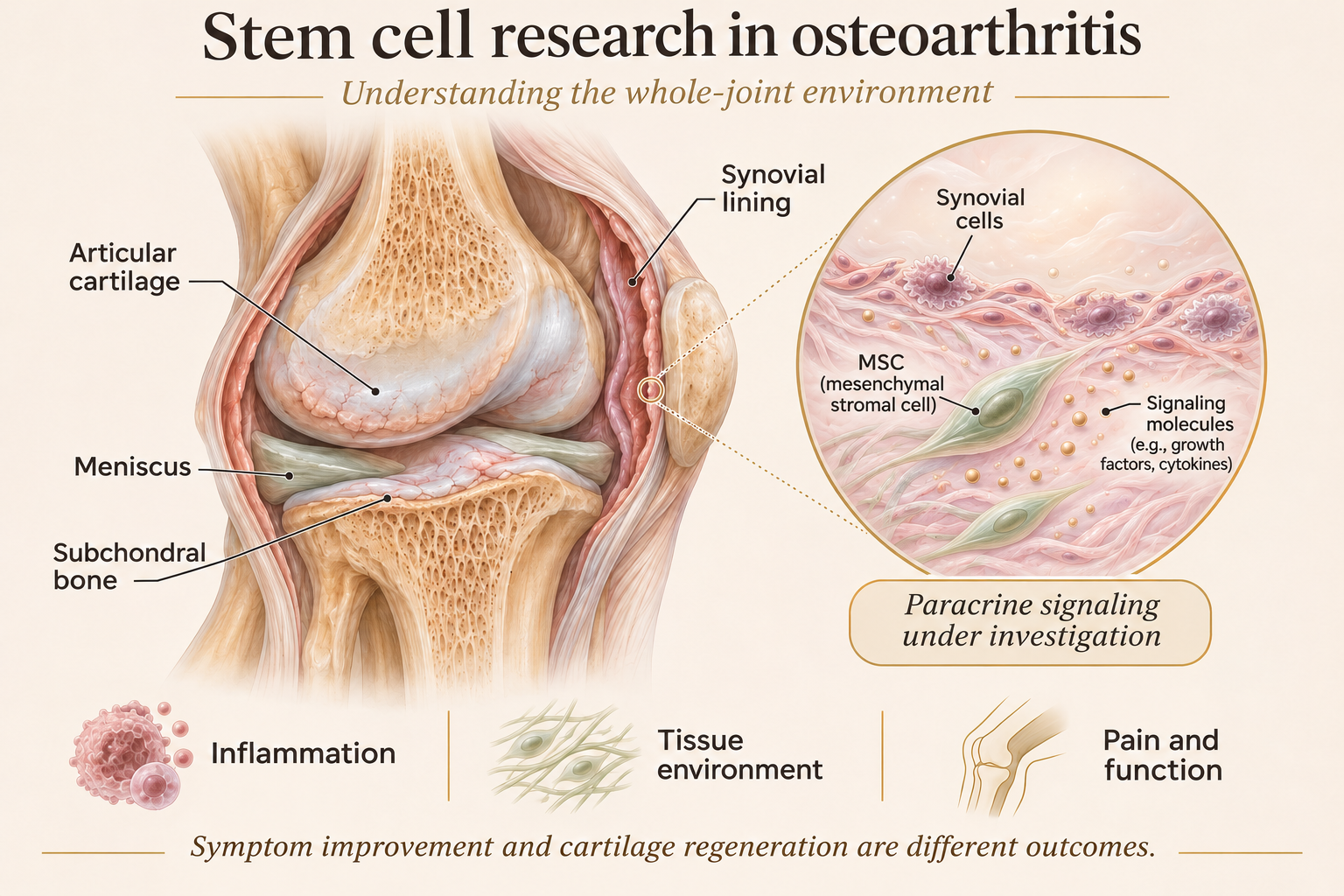
Cutaway knee identifying cartilage, meniscus, subchondral bone and synovial lining, with an inset of MSC-related paracrine signaling under investigation.
MSC research explores activity within the tissue environment, including interactions relevant to inflammation and repair. SVF studies investigate a mixed adipose-derived population. BMAC and PRP introduce different materials and have their own evidence base.
These distinctions matter because a shared term such as regenerative injection can hide important differences. The MSC and SVF guides explain preparation biology in depth; this page focuses on what knee osteoarthritis trials have actually measured.
For the patient, the therapeutic aim should be explicit. Pain relief, better walking and structural cartilage change are separate outcomes. Each is valuable to investigate, but one should not be presented as proof of another.
A phase III trial enrolled 146 people with grade 2 or 3 knee osteoarthritis. The tested allogeneic bone marrow MSC preparation improved WOMAC pain, stiffness and function outcomes compared with placebo at six and twelve months. Both groups also received hyaluronic acid. Cartilage volume did not significantly increase. Phase III trial of a bone marrow MSC product in knee osteoarthritis
In a smaller placebo-controlled study, expanded autologous adipose MSCs produced encouraging six-month clinical findings. MRI did not establish cartilage-defect restoration. This supports distinguishing symptomatic improvement from a claim of rebuilding the joint. Lee et al. (2019). Phase IIb placebo-controlled trial of expanded adipose MSCs in knee osteoarthritis. Stem Cells Translational Medicine.
These findings are promising precisely because they address outcomes patients can recognize. Their clinical relevance depends on the tested preparation, patient selection and follow-up, rather than on the phrase stem cell therapy alone.
MILES enrolled 480 participants and compared bone marrow concentrate, SVF and an umbilical-cord tissue MSC preparation with corticosteroid injection. The cellular approaches did not outperform corticosteroid on the main pain outcomes at one year. This is important context when discussing the range of available options. MILES trial comparing cellular preparations with corticosteroid injection
Positive and neutral studies need not be reduced to opposing slogans. They ask different questions with different products and comparators. A clinically useful interpretation examines the preparation, disease severity, concurrent care, endpoint and duration together.
A recommendation should therefore explain why a particular option deserves consideration for your joint and goals. It should also address exercise-based rehabilitation, weight management where appropriate, medicines, other injections and orthopedic assessment when indicated.
| Outcome | How it may be assessed | What it does not establish alone |
|---|---|---|
| Symptoms | Pain ratings, stiffness and WOMAC scores. | New cartilage formation. |
| Function | Walking, stairs and activity-based measures. | A change in every structural feature. |
| Structure | Appropriate imaging and defined measurements. | A benefit the patient can necessarily feel. |
WOMAC evaluates pain, stiffness and physical function. A trial may report a change in the total score, changes in individual domains, or the proportion of participants reaching a prespecified response. These are related but different descriptions of benefit.
A comparison with placebo asks a different question from a comparison with an active injection. Follow-up duration also matters: improvement at one time point does not establish the same effect indefinitely. Group averages describe study populations and cannot predict an individual response with certainty.
For structural research, MRI measurements should identify the feature and region being assessed. Cartilage volume, cartilage defects and compositional imaging are not interchangeable endpoints. Keeping these distinctions clear allows genuinely encouraging symptom findings to stand on their own, without adding an unsupported claim of complete joint restoration.
03 · Your practical guide
Bring available X-rays or other imaging reports, medication details and a summary of previous injections, surgery and rehabilitation. Explain which joint is affected, what worsens symptoms and which activities you hope to improve.
The assessment should identify the main sources of limitation and whether the proposed procedure fits the clinical picture. You should understand the preparation, administration, likely recovery arrangements, alternatives, cost and relevant risks, including injection-related infection, bleeding or a painful flare. Autologous procedures may also require discussion of tissue collection.
Establish a baseline before treatment. A walking distance, stair task or standardized symptom score makes change easier to assess. Agree on review points and how appropriate movement and rehabilitation will fit around the procedure. Do not change medicines or activity restrictions without individualized advice.
You do not need to decide which regenerative approach is right before your consultation. Begin with your joint concerns and movement goals. The physician can explain the available options in the context of your findings and the evidence.
Face-to-face consultations are available in Davao City, with teleconsultations available to begin the discussion. The team confirms appointments by phone or email. The purpose is a clear, individualized route toward more useful movement.
Not necessarily. Pain and function are different outcomes from structural cartilage change. The distinction should remain clear when discussing research or progress.
No. Joint findings, previous treatment, medical circumstances and preparation-specific evidence inform the decision.
The clinical team should explain how appropriate movement and rehabilitation fit into the plan, including any procedure-specific activity guidance.
Explore what this science could mean for you.
Bring your questions to Sure Health 360 Center for Regenerative Medicine and Cell Therapy. Consult in Davao City or begin with a teleconsultation. Appointments are confirmed by phone or email.
Request a consultationExplore all 14 services · Explore all care pathways · Meet your physician and clinic
The publications below report external research. They do not represent outcomes measured at our clinic.