Care by Condition / CardioRehab
Understanding repair after a heart attack, with strength and daily life in view.
Discuss your careAfter a heart attack, returning home is an important milestone. Recovery continues as you rebuild confidence in walking, working, sleeping, and being active with your family. Some people recover good function; others live with breathlessness, fatigue, or a weakened heart.
Stem cell research explores whether cellular signals can influence the healing environment after injury. The scientific aim is to support the surviving heart muscle and investigate changes in blood supply, inflammation, and remodeling. This is different from reopening a blocked artery, which remains an urgent part of acute heart-attack care.
At Sure Health 360 Center for Regenerative Medicine and Cell Therapy, a consultation considers your recovery stage, current heart function, cardiology treatment, and the activities you hope to regain. It is an opportunity to examine regenerative options within the wider plan protecting your heart.
An interrupted coronary blood supply deprives part of the myocardium of oxygen. Reopening the artery can save threatened tissue, but muscle that has already died is generally replaced by scar. The healing response includes inflammation, removal of damaged material, formation of supporting tissue, and changes in the surviving muscle.
The border between scar and surviving myocardium is scientifically important. Microvascular function, mechanical stress, and the inflammatory environment influence how the ventricle adapts. Remodeling can change chamber size and pumping efficiency. The research question is therefore broader than whether a treatment creates new heart cells: it includes whether the remaining heart can function more effectively.
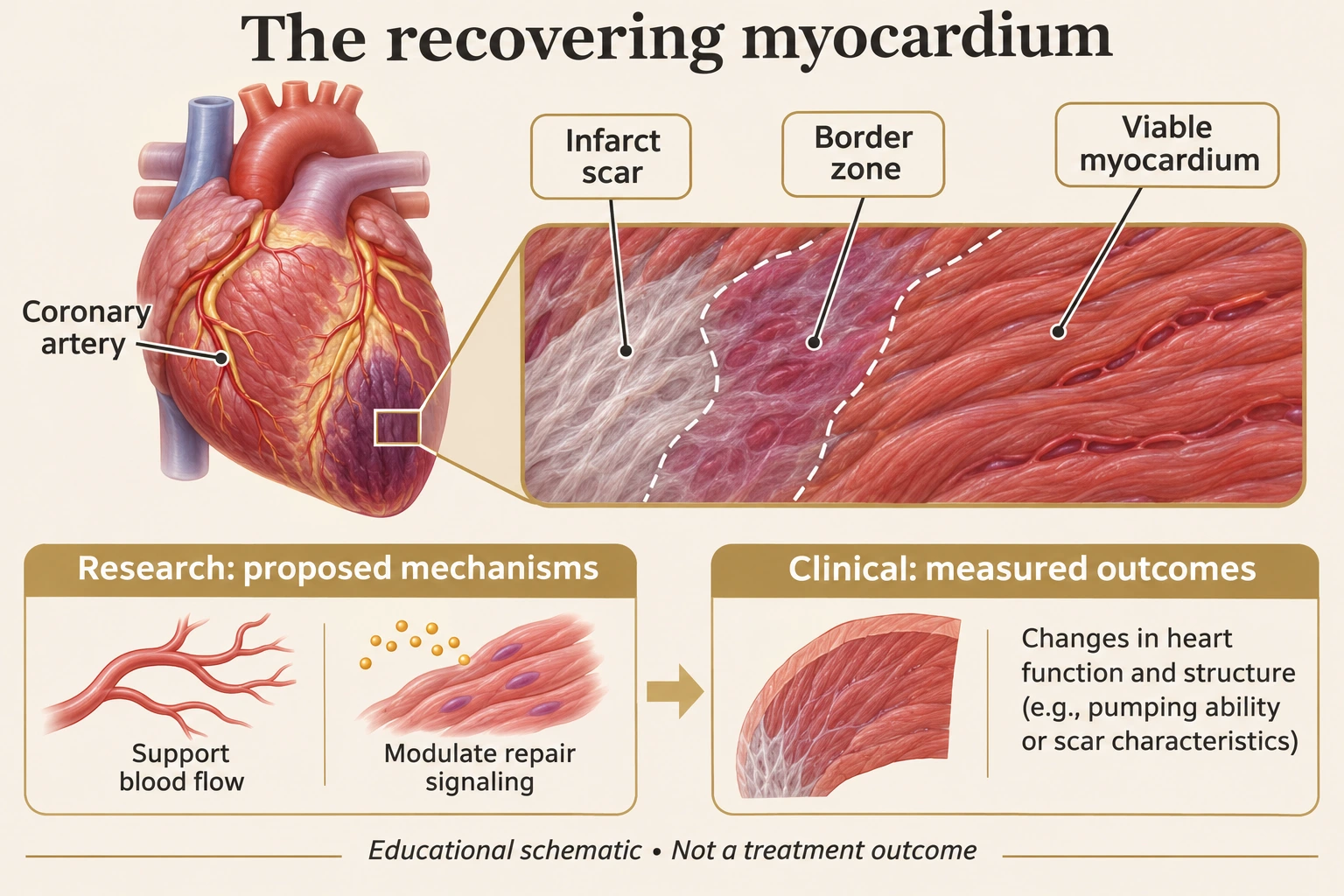
After myocardial infarction, scar, surviving myocardium and the border zone form a complex recovery environment. The diagram does not depict scar reversal.
Trials have investigated bone-marrow mononuclear preparations, MSCs, and other cell products. These are different biological interventions. A mixed mononuclear preparation should not be described as a purified stem-cell product, and MSC findings should not be transferred automatically to exosomes or another cell source.
MSC research examines paracrine activity, including signals potentially relevant to immune behavior, vascular support, and tissue remodeling. Clinical evaluation must then ask whether these biological effects produce meaningful changes in symptoms, exercise capacity, hospital admissions, or survival. A proposed mechanism is the starting point for that evaluation, not its conclusion.
Delivery also matters. Intracoronary administration delivers a preparation through the coronary circulation. Intravenous administration has different distribution. A result obtained shortly after reperfusion cannot simply predict the effect of a different product given years after the event.
A randomized study of 116 patients with acute ST-elevation myocardial infarction tested intracoronary Wharton’s jelly-derived MSCs several days after successful reperfusion. It reported improvements in measures of myocardial viability and perfusion, and a larger improvement in left-ventricular ejection fraction at 18 months than placebo. These findings make the interaction between cellular signaling and post-infarction recovery worthy of further study. They concern a specific product, route, and early treatment window. [MI1]
The larger research story is not uniform. BAMI investigated intracoronary bone-marrow mononuclear cells after a heart attack, but recruitment and event rates were too low for the planned definitive comparison. Its experience illustrates why survival claims require adequately powered trials rather than inference from imaging changes. [MI2]
Ejection fraction estimates the proportion of blood expelled from the ventricle with each beat. It is useful, but it is not a percentage of overall health or a direct measure of how well someone can live. Imaging should be considered alongside walking tolerance, symptoms, rhythm, admissions, and quality of life.
Your priorities may include walking without frequent stops, returning to work, or managing daily activities with less fatigue. Establishing these priorities creates a more useful framework for discussion than a general promise to “regenerate the heart.”
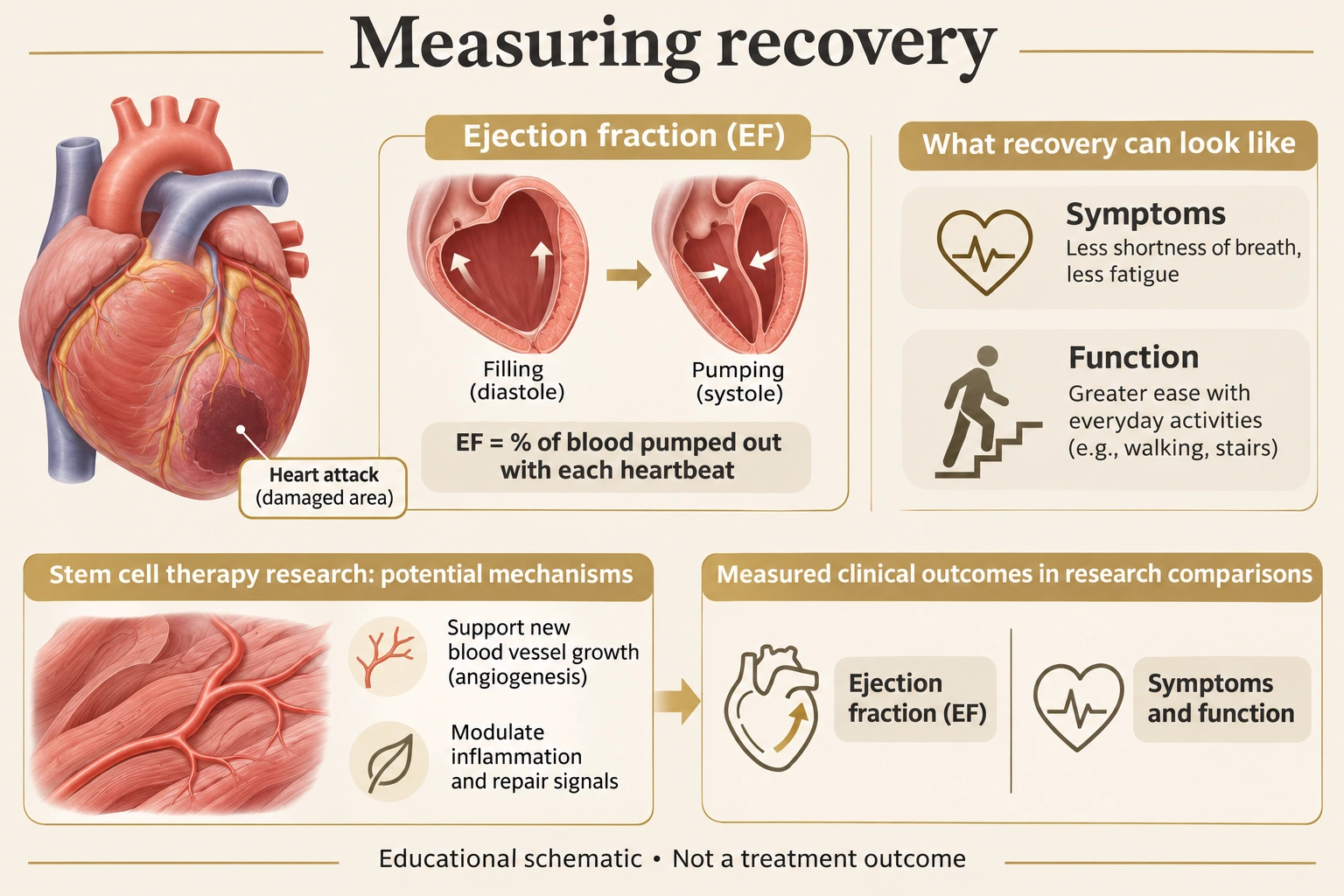
Ejection fraction describes ventricular pumping, while symptoms and function describe other aspects of recovery. No single measure captures the whole patient. Ejection fraction is the stroke volume divided by end-diastolic ventricular volume.
Bring your discharge summary, coronary angiogram or intervention report, latest echocardiogram, medication list, and any cardiac rehabilitation assessments. Tell us when the heart attack occurred and whether you have had chest discomfort, swelling, fainting, or a recent admission.
Continue your prescribed cardiac medicines and rehabilitation unless your treating clinician changes the plan. The consultation can clarify whether a regenerative approach has a reasoned place in your recovery, what the proposed product actually is, and how progress would be measured. Any procedure-specific risks and alternatives should be discussed against your cardiac status, including rhythm and blood-thinning treatment.
Face-to-face consultations are available in Davao City, with teleconsultation as a starting point for patients elsewhere. Appointments are confirmed by phone or email. New chest pressure, severe breathlessness, or collapse needs urgent assessment rather than an online consultation request.
Does this replace a stent or bypass? No. Restoring blood flow and preventing further cardiovascular events have different purposes from investigational regenerative approaches.
Can it remove an established scar? Current clinical evidence does not justify a promise that an established scar will disappear.
What should I ask about a proposed treatment? Ask about the exact cell preparation, route, evidence relevant to your recovery stage, expected follow-up, and how it fits with your cardiologist’s plan.