
Care by Condition / NeuroRegen
The science of recovery, directed toward abilities that make daily life more independent.
Discuss your careSpinal cord injury can change movement, sensation, bladder and bowel routines, skin care, and the level of help needed each day. For one person, progress may mean easier transfers. For another, it may mean better hand use or greater participation in family life.
Cellular research is exploring the injured cord and the environment around surviving neural pathways. That is a compelling field because even a specific functional gain may matter greatly. At Sure Health 360 Center for Regenerative Medicine and Cell Therapy, the discussion begins with the level and extent of injury, medical stability, rehabilitation, and the functions you hope to improve.
The initial trauma can damage axons, blood vessels, supporting cells, and the tissue architecture of the spinal cord. Secondary processes can extend that injury through inflammation and changes in the local environment. Later, tissue loss, scarring, and persistent neurological deficits create a different biological setting from the immediate period after trauma. Timing therefore changes the question a treatment is trying to answer. [SCI]
The cord is not simply an electrical cable that can be reconnected by adding cells. Useful recovery depends on functioning pathways, appropriate connections, sensory feedback, muscle capacity, and practice. Research into inflammatory regulation or trophic support addresses parts of that problem; it does not by itself demonstrate reconstruction of an entire pathway.
An injury’s neurological level helps describe where function is affected. Completeness concerns preserved neurological function, including sacral function, rather than what the person can accomplish in a single observed task. Clinical examination and formal classification provide a more reliable foundation than labels such as “severe” or “partial.”
This distinction matters when comparing research participants with an individual patient. A change in an impairment classification is not interchangeable with independent walking, hand dexterity, or bladder control. A meaningful treatment discussion should identify both the neurological measure and the everyday outcome being considered.
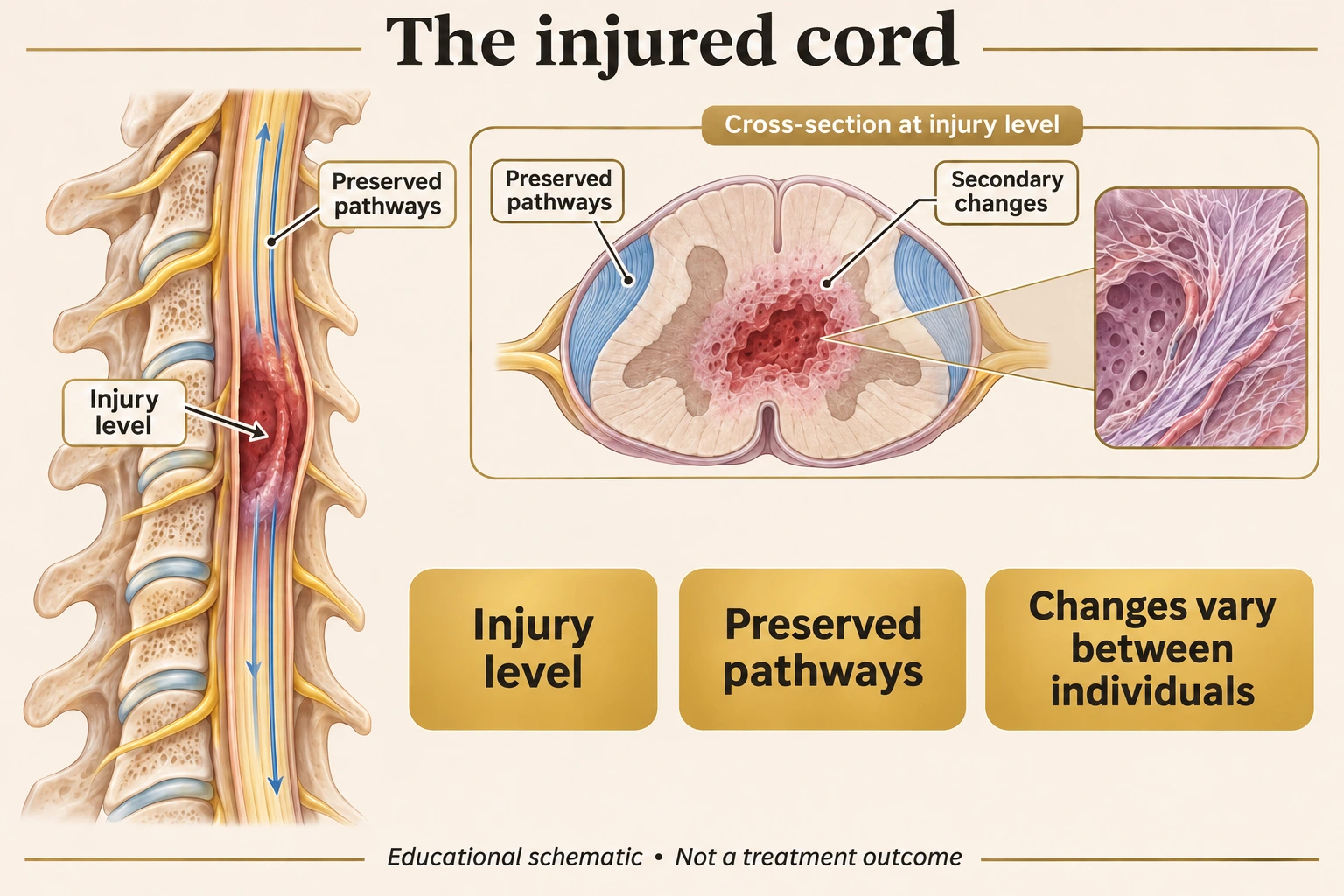
Spinal cord injury can affect pathways carrying movement and sensory information. The pattern and extent of preserved tissue differ between injuries.
MSC research investigates whether cellular activity can influence the environment around injured tissue. Proposed actions include interactions with immune cells and the release of signaling molecules relevant to tissue support. Different preparations and delivery routes are being explored. Intravenous delivery and intrathecal delivery, which introduces a preparation into cerebrospinal fluid, are different interventions with different practical and safety considerations. [SCI]
The useful clinical question is specific: which preparation has been studied in people with this type and stage of injury, by which route, and with what follow-up? The presence of a plausible mechanism is a reason to investigate, not a substitute for those details.
The 2024 CELLTOP phase I study investigated intrathecal autologous adipose-derived MSCs in ten people with traumatic spinal cord injury. Safety was its primary focus, and neurological improvements were reported in some participants. The absence of a randomized control group and the small sample mean the findings cannot establish a predictable recovery rate or identify who will respond. [SCI]
The importance of this work is that it brings a defined preparation into carefully observed human research. It provides a foundation for larger studies and better questions about injury characteristics, timing, function, and durability. It should not be translated into a promise that another preparation will produce the same result.
At Sure Health 360 Center for Regenerative Medicine and Cell Therapy, assessment considers spinal stability, previous surgery, current complications, rehabilitation progress, and other medical conditions. Any discussion of cell therapy should fit alongside the rehabilitation and specialist care already supporting you.
Pressure injury, infection, pain, spasticity, respiratory limitations, and bladder or bowel problems can influence both readiness for a procedure and daily function. Addressing these concerns can be important in its own right. If a procedure is considered, the physician should explain the preparation, route, expected course, alternatives, and the monitoring required.
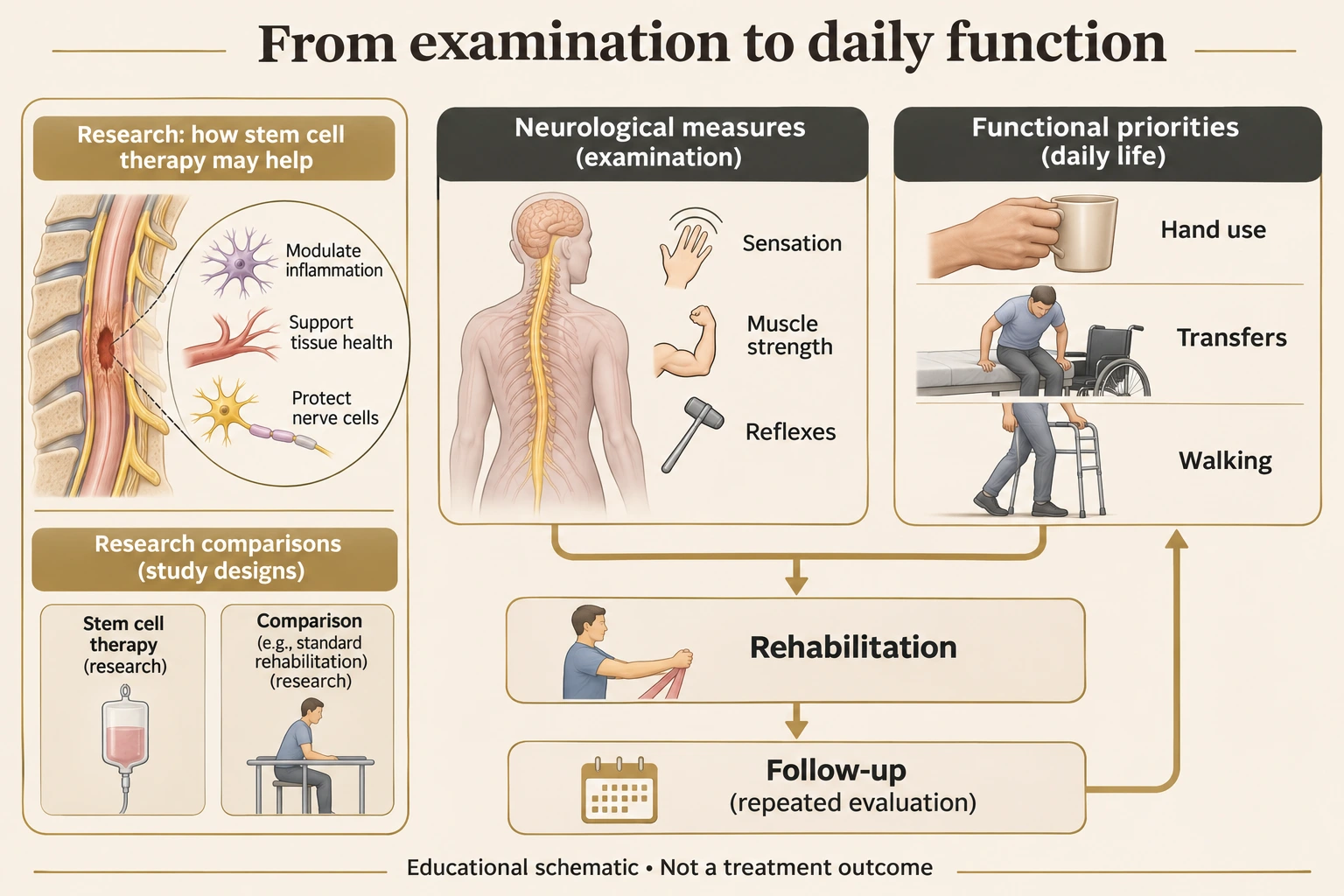
Neurological examination and daily function answer related but distinct questions. Rehabilitation connects assessment with goals such as hand use, transfers and mobility.
Bring the injury and surgery timeline, MRI reports and available images, rehabilitation assessments, medication list, and any formal neurological classification. Note recent infections, skin problems, changes in bladder routines, or changes in strength or sensation. Describe your current assistance needs and the activities that matter most to you.
Follow-up should record a baseline before treatment. Depending on your circumstances, that may include standardized motor and sensory examination, transfers, wheelchair skills, upper-limb tasks, or an independence scale. Repeated assessments should use comparable conditions and distinguish rehabilitation gains from any unproven treatment attribution.
Is walking the only meaningful outcome? No. Hand function, transfers, personal care, comfort, and participation may be important priorities, depending on the injury.
Does the research apply to my injury? That depends on the injury type, stage, preparation, and route studied. Bring your records so the comparison can be made explicitly.
Can we start remotely? A teleconsultation can begin the discussion. An examination may still be needed before treatment planning. Appointments are confirmed by phone or email.