Care by Condition / NeuroRegen
Exploring the biology of movement, with everyday independence in view.
Discuss your careParkinson’s disease can make movement less automatic. Getting dressed, turning in bed, writing, walking through a doorway, or joining a family outing may require more effort and planning. Sleep, mood, constipation, and fatigue can be just as important as tremor.
Regenerative medicine asks two particularly interesting questions: can specialized cells help restore dopamine signaling, and can other cellular approaches influence the environment in which vulnerable neurons function? These questions are driving different research programs. Understanding that difference helps turn a general interest in “stem cells” into a useful clinical conversation.
At Sure Health 360 Center for Regenerative Medicine and Cell Therapy, the starting point is your diagnosis, medication response, daily abilities, and priorities. The goal is a reasoned discussion of the specific option available to you, alongside your continuing neurological care.
Neurons in the substantia nigra normally supply dopamine to the striatum, helping regulate movement through connected basal-ganglia circuits. Loss of that input contributes to slowness and rigidity. Dopamine replacement can improve important motor symptoms, but Parkinson’s also involves systems beyond this pathway. A treatment that improves a motor score does not necessarily improve balance, cognition, autonomic symptoms, or the entire course of the disease. [PD2]
This is why research needs more than a general “better or worse” assessment. Motor examination, daily function, medication state, nonmotor symptoms, and sustained follow-up answer different questions. A person assessed shortly after medication cannot be directly compared with someone assessed in an OFF-medication state without accounting for that difference.
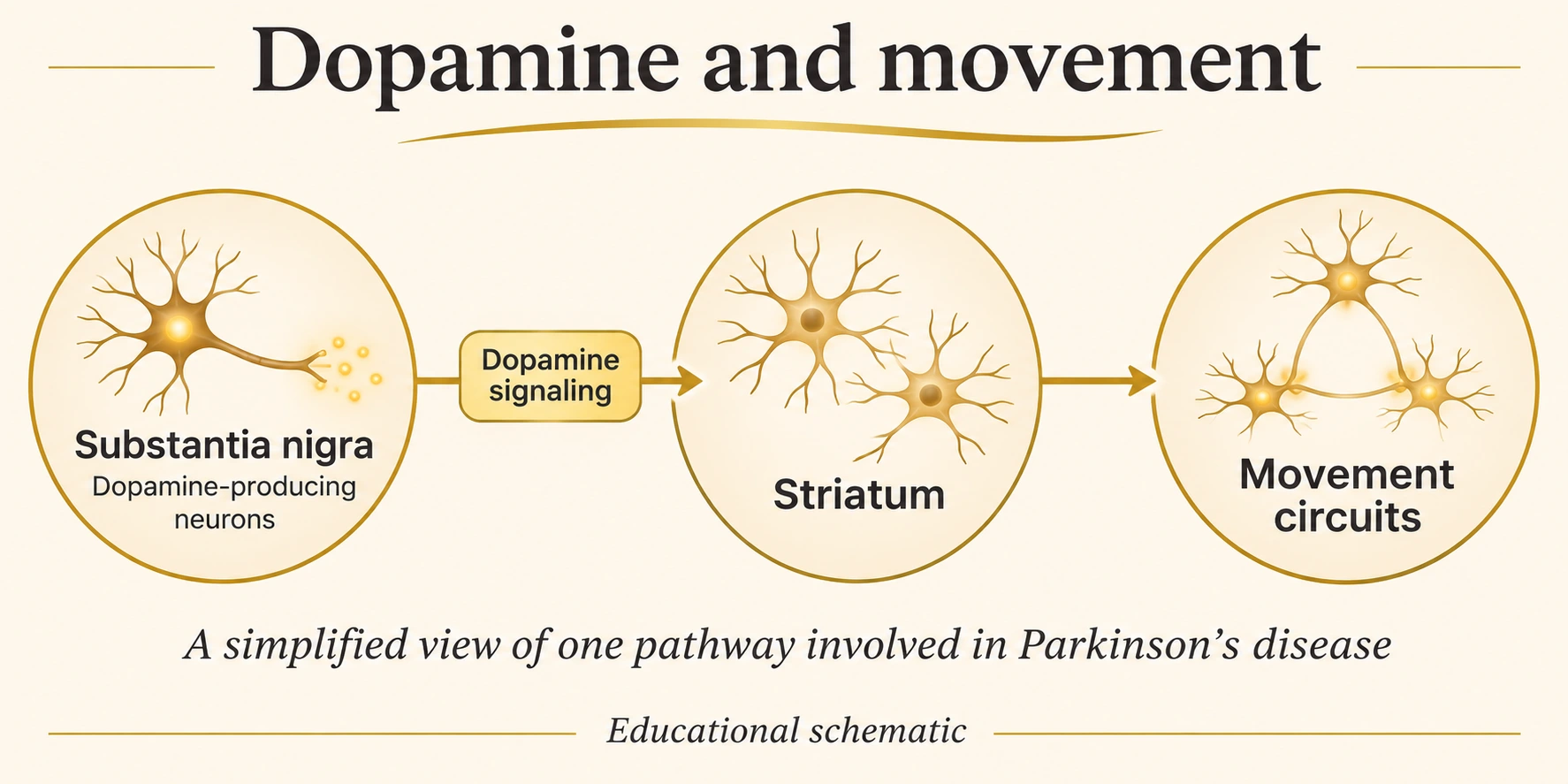
Dopamine signaling between the midbrain and striatum contributes to movement regulation. Parkinson’s disease also involves processes beyond this pathway.
In dopamine-cell replacement, pluripotent stem cells are directed toward a dopaminergic lineage before implantation into a defined brain region. The relevant questions include cell identity, survival, dopamine production, integration, immune management, and effects on movement. This is a specialized transplantation approach, not the same procedure as an intravenous MSC infusion. [PD2]
MSC approaches focus on biological signaling and interactions with inflammatory and immune processes. Their rationale does not require the cells to become replacement dopamine neurons. Source, manufacturing, functional activity, dose, and route therefore remain central to interpreting an MSC study. Cells carrying the same broad label may differ in properties relevant to treatment. [PD1]
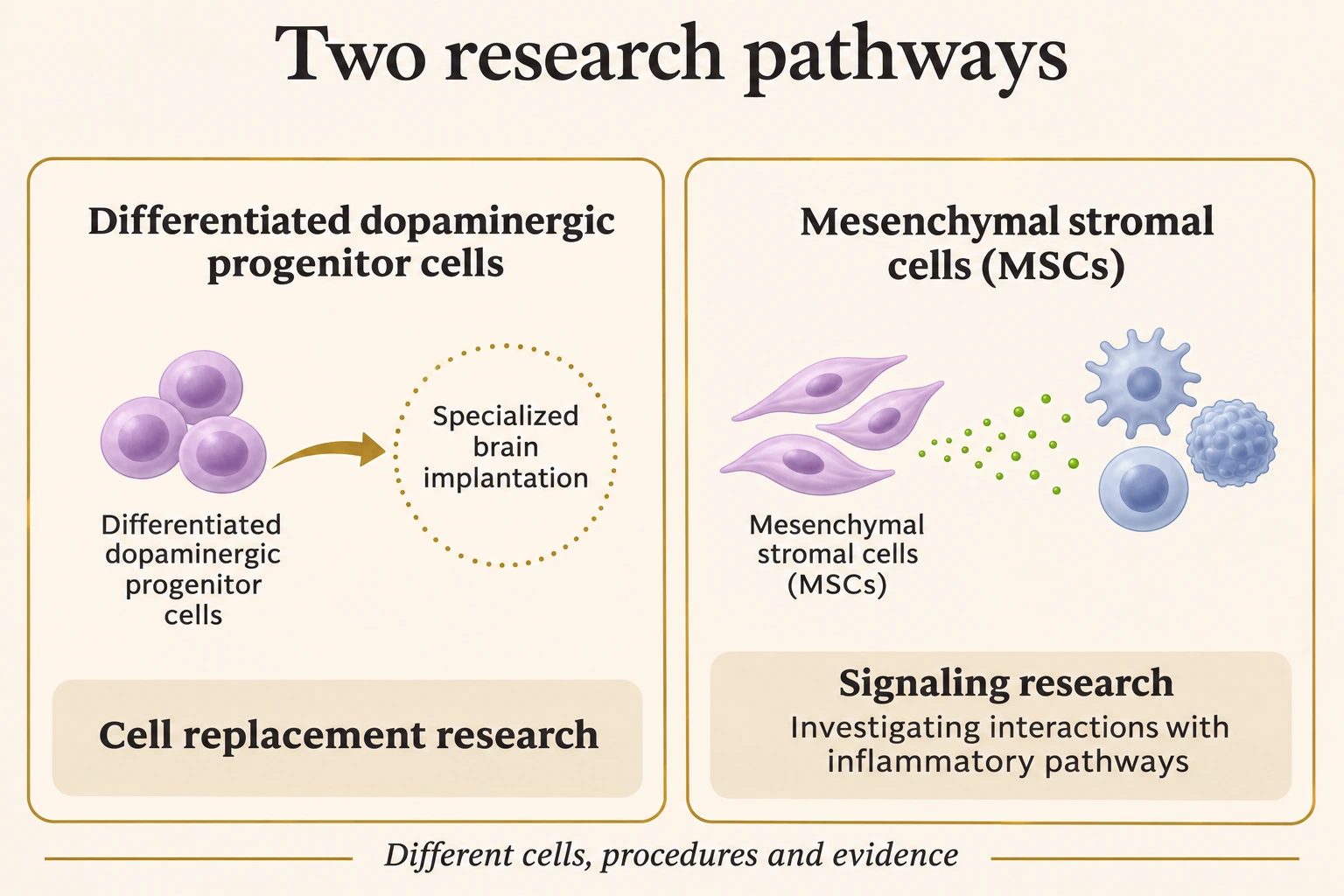
Dopamine-cell replacement and MSC signaling research investigate different therapeutic strategies. Their cells, delivery methods and evidence are not interchangeable.
A 2025 phase I/II study of iPS-cell-derived dopaminergic progenitors reported graft survival, dopamine production, and encouraging motor findings. Its small, open-label design supports further investigation; it does not establish an equivalent effect from other cell types or routes. This is an important advance in a particular cell-replacement strategy. [PD2]
A separate 2025 randomized MSC trial enrolled 45 people with mild-to-moderate Parkinson’s disease. The three-infusion arm met the study’s Bayesian responder criterion, but placebo participants also improved substantially, and the two-infusion arm performed less well. The findings support further work on reproducibility and product potency rather than a universal infusion schedule. [PD1]
In a 2026 randomized trial involving 24 participants, repeated intravenous adipose-derived MSCs did not show a clear benefit on the primary daily-living outcome. Reading these studies together makes the scientific opportunity more specific: the preparation, endpoint, and clinical population matter. [PD3]
A consultation should distinguish the intervention described in a publication from the preparation actually being proposed. Ask what it contains, what human evidence is relevant, how it is administered, and what outcome the physician hopes to influence. Specialized brain implantation described in external trials should not be assumed to be a service offered onsite.
Your neurologist’s treatment remains part of this discussion. Medicines, physiotherapy, speech and swallowing support, exercise, and device-based treatments can have different roles. A regenerative consultation should help organize those decisions around your needs, not leave you to choose between unrelated options without explanation.
Bring a medication list with dosing times, a short account of ON and OFF periods, recent neurology notes, and any relevant imaging. Describe falls, freezing, dizziness, swallowing difficulty, sleep changes, and the tasks that have become hardest. With your agreement, a family member can add observations that a short appointment may miss.
Select two or three concrete priorities, such as turning safely, walking to a nearby shop, or managing buttons. Follow-up can pair those goals with a standardized motor examination and a consistent medication-state assessment. Do not change Parkinson’s medicines to prepare for a consultation unless your treating clinician specifically directs it.
Could this replace my medication? A study of cell therapy does not establish that medication can be stopped. Any adjustment requires clinical review.
Would improvement mean the disease has reversed? Better function is valuable, but symptom improvement, restoration of a particular circuit, and slowing progression are different claims. The proposed plan should explain which is being assessed.
What happens next? Begin with a face-to-face consultation in Davao City or a teleconsultation. Appointments are confirmed by phone or email.