
Care by Condition / Signature Longevity
Scientific attention to strength, resilience, and the years you want to live well.
Discuss your careHealthy ageing is about more than a number. It includes walking confidently, recovering after illness, participating in family life, and maintaining the ability to make your own choices. When strength and reserve decline, an illness or a period of inactivity can have a disproportionate effect.
Frailty describes a state of reduced physiological reserve. It is not an inevitable label for every older person, and it deserves a careful assessment. Regenerative research is exploring whether cellular approaches can influence biological processes associated with this vulnerability.
At Sure Health 360 Center for Regenerative Medicine and Cell Therapy, the discussion starts with your function, health history, and priorities. The aim is to connect scientific possibility with the practical work of preserving independence.
Physical resilience depends on muscle, circulation, nervous-system function, nutrition, and the ability to respond to physiological stress. Persistent inflammatory activity and changes in vascular and immune function are among the processes being investigated in ageing research.
Frailty and chronological age are not interchangeable. Two people of the same age can have very different strength, walking speed, medical burdens, and support needs. A meaningful assessment therefore looks beyond a birth date or a single “biological age” score.
Cellular research examines whether the signaling properties of MSC preparations can influence aspects of this systemic environment. The hypothesis is not simply that adding younger cells makes the whole body younger. It concerns defined products, measurable biological activity, and specific functional outcomes.
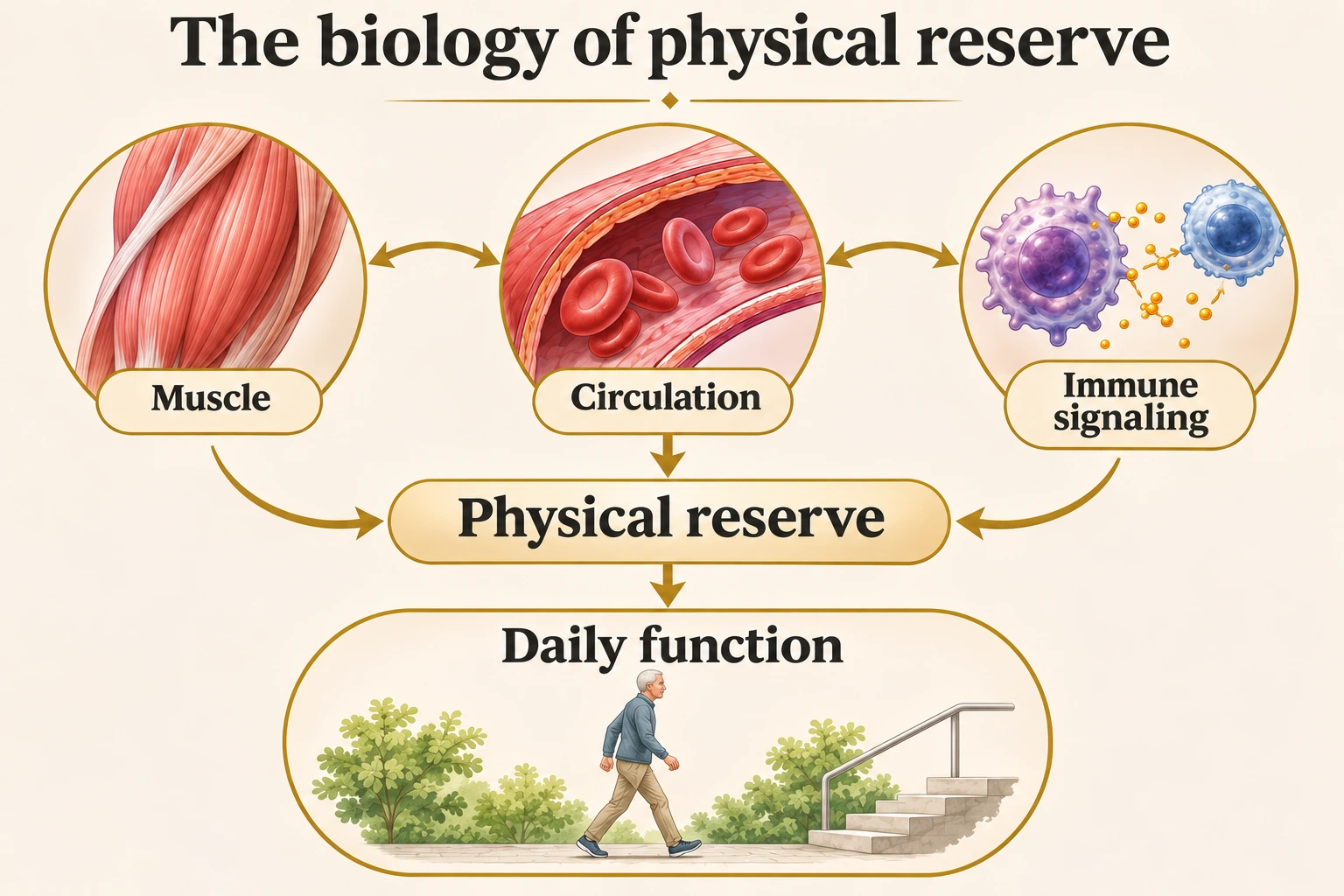
Physical reserve reflects connected muscular, vascular, immune and functional systems. It cannot be reduced to chronological age alone.
A randomized phase 2b study of laromestrocel enrolled 148 ambulatory older adults with frailty. The study reported dose- and time-dependent signals in six-minute walking distance. The reported comparison at nine months favored treatment, while the corresponding six-month estimate did not reach conventional statistical significance. [FRAIL]
The research is encouraging because it focuses on a practical capability rather than a cosmetic change. Findings involving physical function and vascular-associated biomarkers also help guide further investigation. They do not establish that any MSC product reverses ageing, extends lifespan, or prevents all age-related disease. The participants, preparation, dose, and follow-up are central to understanding the result. [FRAIL]
Walking distance can reflect several systems at once. Muscle strength, joint pain, cardiopulmonary health, balance, motivation, and familiarity with the test may all influence performance. Measurements should be consistent and interpreted alongside daily abilities and medical changes.
Similarly, a biomarker is not a complete portrait of a person’s health. A change in a laboratory result may be scientifically interesting without proving improved independence. For a patient, a useful plan connects measurements to specific goals: getting out of a chair more easily, walking to a nearby shop, or returning to a valued activity.
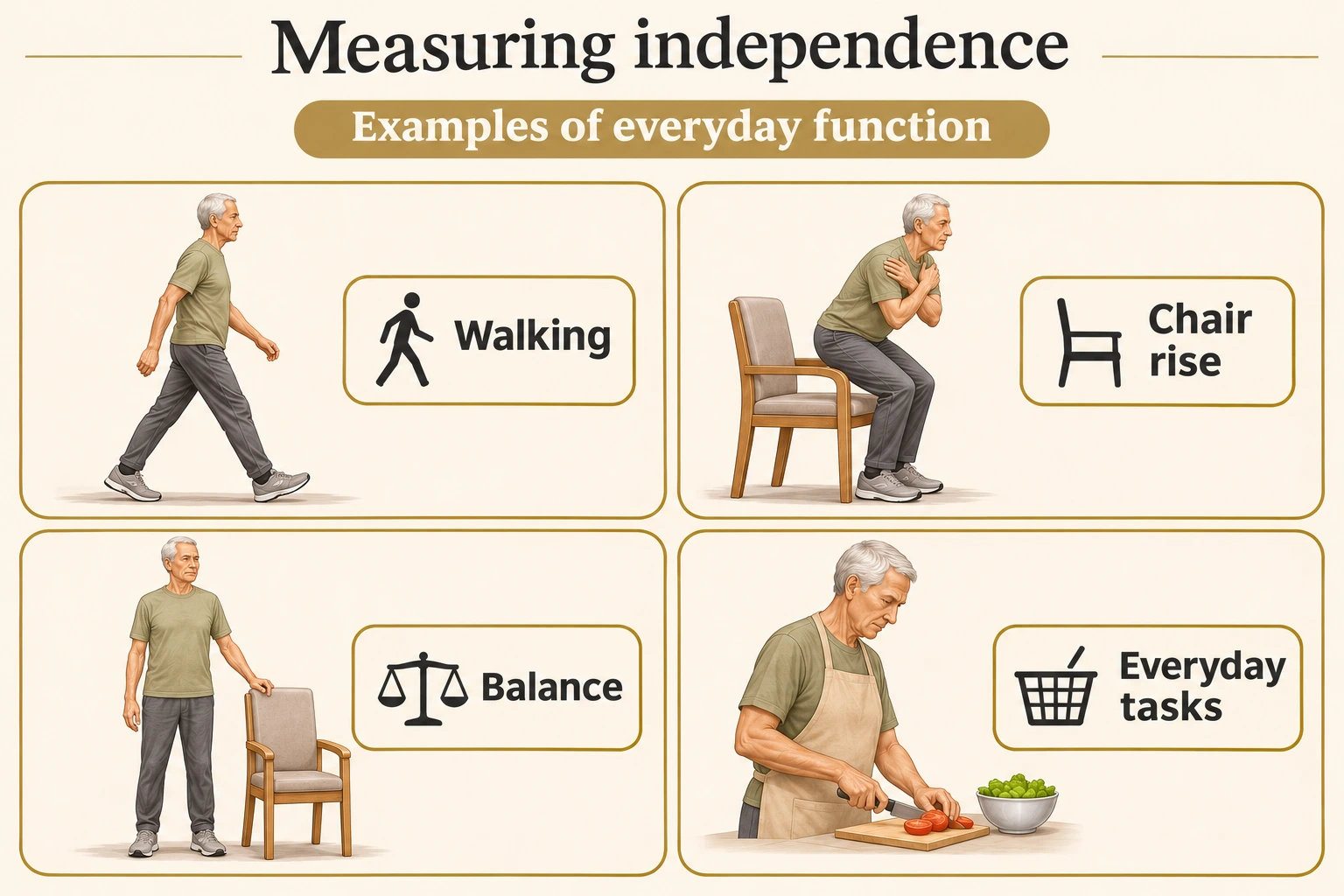
Walking, chair rise, balance and daily activities help describe physical function. These are assessment concepts, not testimonials or guaranteed outcomes.
Assessment can identify reversible contributors to reduced reserve, including medication effects, nutritional problems, inactivity, or an untreated medical condition. Strength and balance work, appropriate nutrition, management of chronic illness, and social support remain important parts of healthy ageing.
A regenerative intervention, if considered, should have a defined purpose alongside these foundations. A broad package of infusions, peptides, or tests should not be presented as a proven route to a longer life simply because its components are available. Each component deserves a clear rationale and a way to judge its usefulness.
Bring your medication and supplement list, recent medical reports, and details of falls, weight changes, hospital admissions, or reduced activity. Describe what has become harder and what you most want to maintain or recover.
The consultation can consider walking ability, strength, balance, daily function, nutrition, cognition where relevant, and the conditions affecting treatment suitability. Discuss the exact proposed product, the evidence in people similar to you, potential complications, and the follow-up needed to measure meaningful change.
Begin face to face in Davao City or by teleconsultation, with your appointment confirmed by phone or email. A family member or support person can contribute useful observations with your agreement. The goal is a plan you can understand and sustain.
Is this an age-reversal treatment? That description goes beyond the evidence. The more useful question is whether a specific intervention can improve a measurable aspect of function.
Can I benefit even if I do not proceed with cellular therapy? A careful assessment can identify practical ways to support strength and health, whether or not a cellular intervention is appropriate.
How will progress be judged? By agreed functional goals and consistent follow-up, rather than a general promise of rejuvenation.