NEUROREGEN · CARE BY CONDITION
Explore the science of recovery, with independence and daily function at its centre.
A stroke changes more than movement or speech. It can change how a person participates in family life and how a family organizes care. Stem cell research is exploring biological approaches to recovery alongside the rehabilitation and medical care that give progress a practical direction.
01 · Patient overview
After a stroke, the important questions are often specific: can I use my hand more effectively, walk with greater confidence, communicate more easily or need less help with daily activities? Those questions should guide the consultation.
Cellular approaches are being investigated for their capacity to influence processes involved in neurological injury and recovery. The aim is not adequately described as putting new cells into the brain. Different preparations explore different mechanisms, delivery routes and treatment windows.
At Sure Health 360 Center for Regenerative Medicine and Cell Therapy, the starting point is your stroke type, time since onset, present function and current care. That context determines which research is relevant to the discussion.
02 · The science in depth
An ischemic stroke interrupts blood flow to part of the brain. Loss of oxygen and metabolic support injures cells and disrupts networks. A hemorrhagic stroke involves bleeding and a different immediate injury process. These diagnoses should not be treated as interchangeable in a research summary.
Recovery involves surviving networks, rehabilitation and adaptation over time. Neuroplasticity describes changes in neural connections and function. It is not equivalent to replacing the entire area of injury with new neurons.
Cellular research investigates several components of this environment, including immune responses, neurovascular interactions and signaling associated with repair. For example, Xin and colleagues reported functional recovery and neurovascular plasticity after administering MSC-derived vesicles in a rat stroke model. This provides mechanistic rationale, not proof of the same clinical effect in people. Xin et al. (2013). MSC-derived vesicles and neurovascular plasticity in a rat stroke model. Journal of Cerebral Blood Flow & Metabolism.
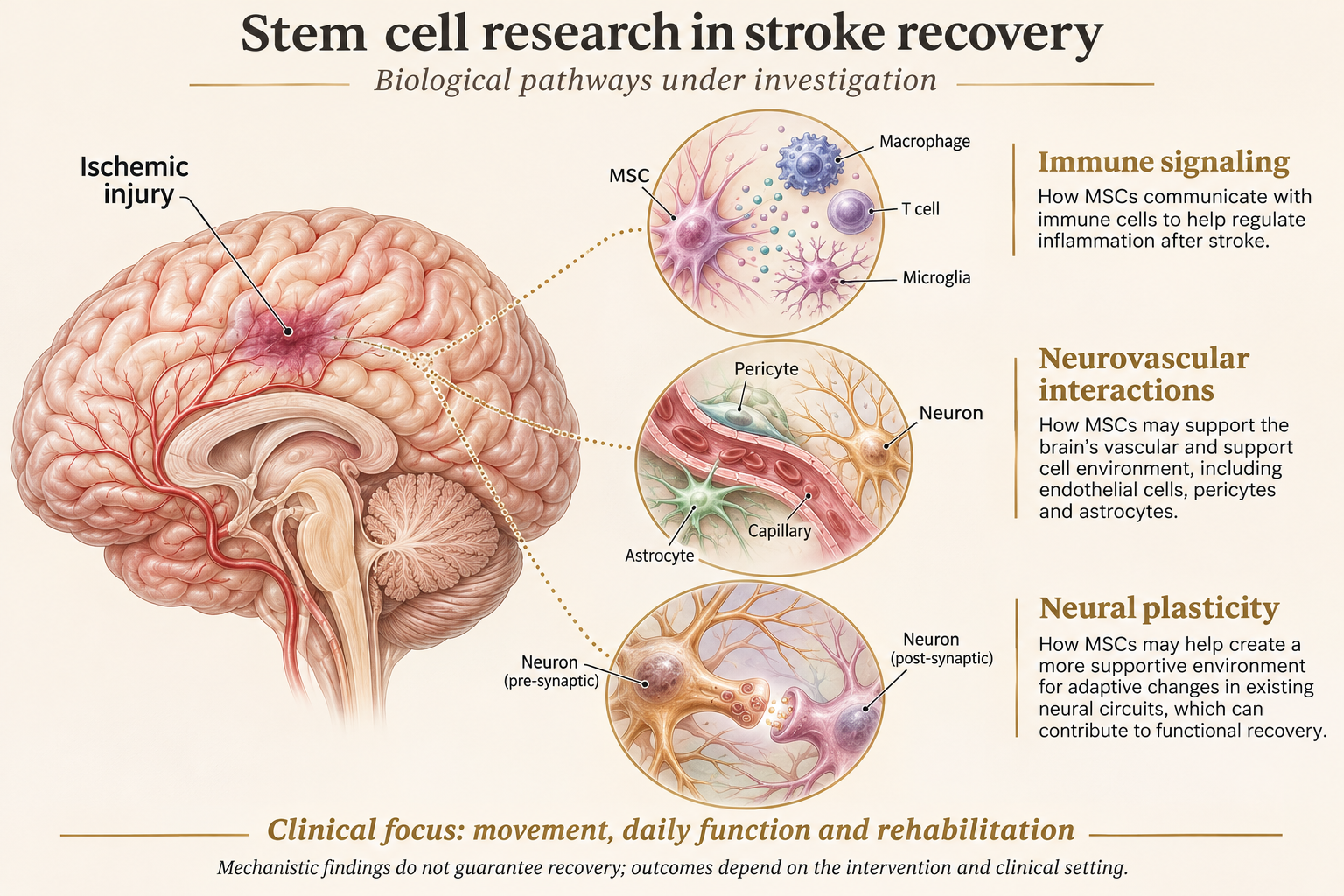
A brain with an ischemic injury region connects to illustrated immune signaling, neurovascular interactions and neural plasticity research concepts.
An intervention studied within hours of stroke addresses a different biological period from one administered weeks or years later. Early trials may investigate modulation of acute injury responses, while later studies ask about functional recovery. Time since stroke is therefore part of the intervention’s context.
Cell identity matters equally. MSCs, Muse-cell products and multipotent adult progenitor cells are different research approaches. Their results should not be pooled casually under a promise that stem cells work for stroke.
A useful consultation connects the actual preparation with the person’s stage of recovery. Current neurological care, prevention of another stroke and rehabilitation remain essential parts of that reasoning.
The CL2020 Muse-cell trial reported an encouraging functional signal in subacute ischemic stroke. The Muse guide provides the detailed study interpretation, including its small sample, treatment window and safety findings. Randomized trial of CL2020 in subacute ischemic stroke
STARTING-2 assessed preconditioned autologous MSCs against standard treatment. Its final analysis included 39 treated and 15 control patients. The primary modified Rankin Scale result did not differ significantly at three months, while a secondary leg-motor measure favored the MSC group. A specific motor signal and a global disability result can therefore tell different parts of the same story. Chung et al. (2021). STARTING-2: intravenous autologous MSCs after ischemic stroke. Neurology.
TREASURE tested an allogeneic multipotent adult progenitor-cell product in acute ischemic stroke. Its primary short-term efficacy endpoint was not met. The trial is useful context because it demonstrates why positive findings from one cellular approach cannot establish effectiveness for every product or window. TREASURE randomized trial in acute ischemic stroke
| Study | Clinical setting | Interpretive focus |
|---|---|---|
| CL2020 | Subacute ischemic stroke. | Promising functional signal; see the Muse guide for full context. Randomized trial of CL2020 in subacute ischemic stroke |
| STARTING-2 | Autologous MSCs after ischemic stroke. | Neutral primary disability result with a secondary motor signal. Chung et al. (2021). STARTING-2: intravenous autologous MSCs after ischemic stroke. Neurology. |
| TREASURE | Acute ischemic stroke; a different cell product. | Primary short-term efficacy endpoint not met. TREASURE randomized trial in acute ischemic stroke |
A global disability scale can miss a smaller but meaningful motor change, while a motor score can improve without a corresponding change in independence. Research interpretation becomes stronger when the primary endpoint is distinguished from secondary and exploratory findings.
The primary endpoint is the main question specified by the trial. Secondary outcomes can add detail and generate hypotheses, but a favorable secondary result should not be presented as though the primary question was answered positively. STARTING-2 illustrates why this distinction matters. Chung et al. (2021). STARTING-2: intravenous autologous MSCs after ischemic stroke. Neurology.
In practice, both standardized measures and personal goals are useful. A change in leg movement should be considered alongside transfers, walking and assistance needs. This allows scientific measurement and the patient’s experience to inform one another.
| Measure | Focus |
|---|---|
| Modified Rankin Scale | Overall disability. |
| Fugl-Meyer assessment | Motor impairment. |
| Barthel Index | Basic daily activities. |
| Personal goals | Participation in everyday life. |
The clinical value of a regenerative approach depends on how it fits with the rest of recovery. A gain in capacity needs opportunities for practice and use. Rehabilitation goals, fatigue, spasticity, pain, cognition and caregiver support can all affect daily progress.
This is why follow-up should document more than a general impression. A baseline assessment and repeated measures can distinguish a useful change in an affected limb from a broader change in independence. Patient and caregiver observations add important context, especially when linked to a specific activity.
Other clinic services should be considered only where there is a clear clinical purpose. Availability of oxygen, light-based or other supportive therapies does not by itself establish a combined stroke-recovery effect. A plan should explain the contribution expected from each component.
03 · Your practical guide
Bring your hospital discharge summary, available CT or MRI reports, current medicines, rehabilitation assessments and information about previous complications. The physician can determine whether the original images or further testing are needed.
Write down two or three practical priorities, such as transferring safely, using an affected hand during meals or walking a particular distance. With your agreement, a family member or caregiver can describe the support required at home.
Assessment should clarify medical stability and the relevance of the proposed intervention. Before treatment, discuss the expected benefit, delivery, relevant risks, alternatives, rehabilitation coordination and follow-up. These details make the opportunity easier to evaluate and prepare for.
You can meet the team in Davao City or begin with a teleconsultation. Appointment confirmation is by phone or email. The consultation is the place to connect the research with your records and goals, without needing to select a therapy in advance.
Sudden new facial drooping, weakness or speech difficulty requires emergency assessment immediately. The pathway described here is for planned recovery care.
You can request an assessment. Research findings and suitability need to be considered for your recovery stage and individual circumstances.
No. Rehabilitation and continuing neurological care remain part of the recovery plan. Any proposed regenerative intervention should be discussed in that context.
Available imaging reports, hospital summaries, medicines and rehabilitation assessments are helpful, along with your questions and functional priorities.
Explore what this science could mean for you.
Bring your questions to Sure Health 360 Center for Regenerative Medicine and Cell Therapy. Consult in Davao City or begin with a teleconsultation. Appointments are confirmed by phone or email.
Request a consultationExplore all 14 services · Explore all care pathways · Meet your physician and clinic
The publications below report external research. They do not represent outcomes measured at our clinic.