
Care by Condition / NeuroRegen
Understanding immune activity, neural injury, and the search for better function.
Discuss your careMultiple sclerosis can affect movement, sensation, vision, energy, and the ability to plan confidently. The experience varies from person to person, and the course can change over time. Patients often encounter the phrase “stem cell treatment” without being told that it can describe substantially different procedures.
At Sure Health 360 Center for Regenerative Medicine and Cell Therapy, a useful discussion begins with the type of multiple sclerosis, current disease activity, existing treatment, and your daily priorities. Regenerative medicine raises important questions about tissue protection and repair. The task is to connect those questions with the evidence relevant to your situation.
Myelin supports efficient signal conduction along nerve fibers. In multiple sclerosis, immune-mediated injury affects myelin and can also damage axons. Inflammation, accumulated tissue injury, and the capacity for repair do not contribute equally at every stage. A treatment directed toward active inflammation may therefore answer a different question from one aimed at progressive disability. [MS2]
MRI lesions, relapses, walking performance, hand function, fatigue, and disability scores describe different aspects of disease. Changes in one do not automatically establish improvement in the others. Scientific interpretation becomes stronger when a study states which process it intends to influence and chooses outcomes that test that intention.
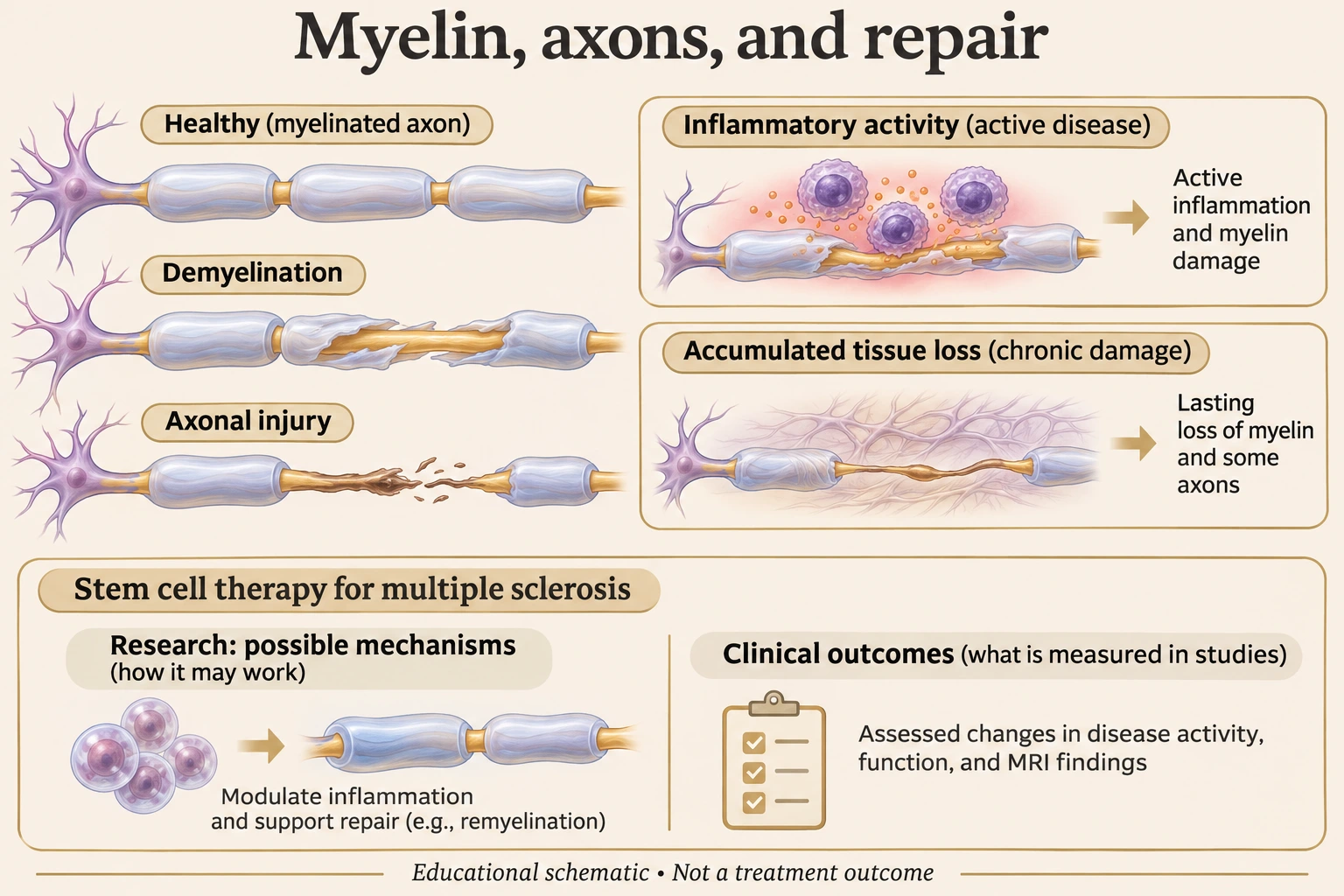
Demyelination affects the insulating sheath around axons. Axonal injury is a distinct process; the two should not be treated as equivalent changes.
Autologous hematopoietic stem-cell transplantation is an immune-reconstitution approach involving intensive treatment and specialist transplant care. It is not the same intervention as an MSC infusion. MSC studies instead investigate immune-modulating and tissue-supporting activity, using defined preparations and routes. Evidence for one pathway should not be used to advertise the other.
Within MSC research, intravenous and intrathecal administration are also distinct. Processing, dose, schedule, disease characteristics, and functional potency can affect interpretation. A shared cell name does not establish a shared clinical result.
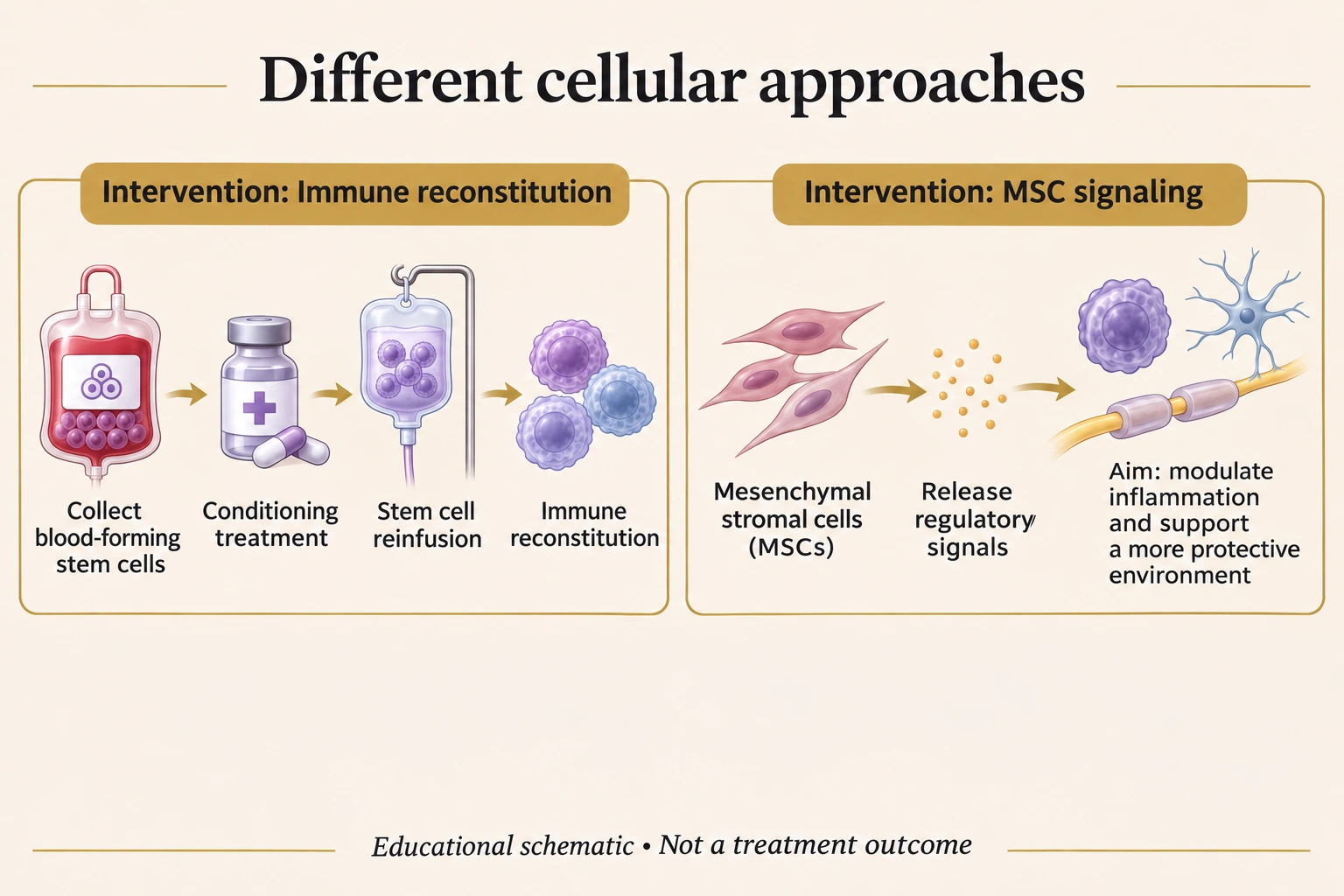
Immune reconstitution and MSC signaling research are different cellular approaches. A procedure’s purpose, evidence and risks depend on the specific intervention.
A randomized study by Petrou and colleagues included 48 people with active progressive disease and compared autologous MSC approaches with sham treatment. It reported encouraging clinical findings, particularly with intrathecal administration, supporting further investigation of this strategy. Its design and population should remain visible when discussing the results. [MS1]
The larger MESEMS trial enrolled 144 participants and tested intravenous autologous bone-marrow MSCs. It did not reduce its primary MRI measure of inflammatory activity. That finding does not answer every repair question, but it does mean this trial cannot support a claim that the tested infusion controlled active disease. [MS2]
The 2026 SMART-MS study enrolled 18 people with progressive disease. It did not demonstrate benefit on its primary neurophysiological endpoint. It also reported treatment-related concerns, including a serious adverse event and inflammatory spinal findings. These observations matter when discussing intrathecal administration and cannot be replaced by a general statement that MSCs are well tolerated. [MS3]
The research remains scientifically important because it separates questions about inflammation from questions about neural repair. A responsible treatment discussion should identify the specific goal, the supporting study, and the ways in which your condition resembles or differs from the study population.
This is also a setting in which coordination with your neurologist matters. Disease-modifying treatment, symptom management, rehabilitation, and a proposed regenerative intervention have different purposes. Stopping effective treatment to pursue an unproven alternative can change disease control. Any changes should be made with the treating team.
Bring your diagnosis and relapse history, MRI reports and images where available, current and previous disease-modifying treatments, recent laboratory results, and rehabilitation assessments. Note infections, recent steroid treatment, and changes in walking, vision, bladder function, or hand use.
Choose goals that can be measured consistently. A timed walk, a hand-function task, fatigue measures, or a daily activity record may complement formal neurological assessment. A temporary improvement after rest or rehabilitation should not automatically be attributed to cell therapy. The follow-up plan should define the observation period and the clinician responsible for reviewing new symptoms.
Is this the same as a stem-cell transplant used to reset the immune system? Not necessarily. Ask for the exact intervention and its purpose. MSC treatment and hematopoietic transplantation must be discussed separately.
Could it be considered alongside my current care? That requires review of disease activity, medication, the proposed preparation, and its evidence. The consultation should include your neurologist’s treatment plan.
What is the next step? Begin with a consultation in Davao City or by teleconsultation. The team confirms appointments by phone or email.