
EXPLORE THE APPROACHES
A distinct stem-cell population is opening focused questions about tissue repair.
Muse cells attract scientific interest because of their stress tolerance, differentiation potential and behavior in injury models. Their story is best understood as a progression from cell discovery to mechanism studies and early human clinical research.
01 · Patient overview
Muse stands for multilineage-differentiating stress-enduring. The name describes a cell population investigated for its ability to withstand stress and display broad differentiation potential. Muse cells are discussed within regenerative medicine, but the term is not a synonym for all MSCs.
For a patient, the attraction is understandable: researchers are exploring whether a population with distinctive repair-related properties can contribute to useful recovery. To understand that promise, it helps to separate what identifies the cell, how it behaves experimentally and what has been observed in people.
02 · The science in depth
Kuroda and colleagues reported Muse cells within adult human mesenchymal cell populations in 2010. SSEA-3 was used to identify the population, and experiments investigated differentiation across the three germ-layer lineages. These findings established a specific biological research program. Kuroda et al. (2010). Identification of Muse cells in adult human cell populations. PNAS.
A germ layer is an early developmental category from which different tissues arise. Showing broad differentiation potential in experiments is scientifically significant, but it does not mean that an administered population will replace every damaged tissue in a patient.
For technical readers, identification, enrichment and functional testing should be considered separately. Detecting a marker in a mixed preparation does not establish that the final preparation has the same composition or behavior as a selected population used in a published study. The exact material remains central to interpretation.
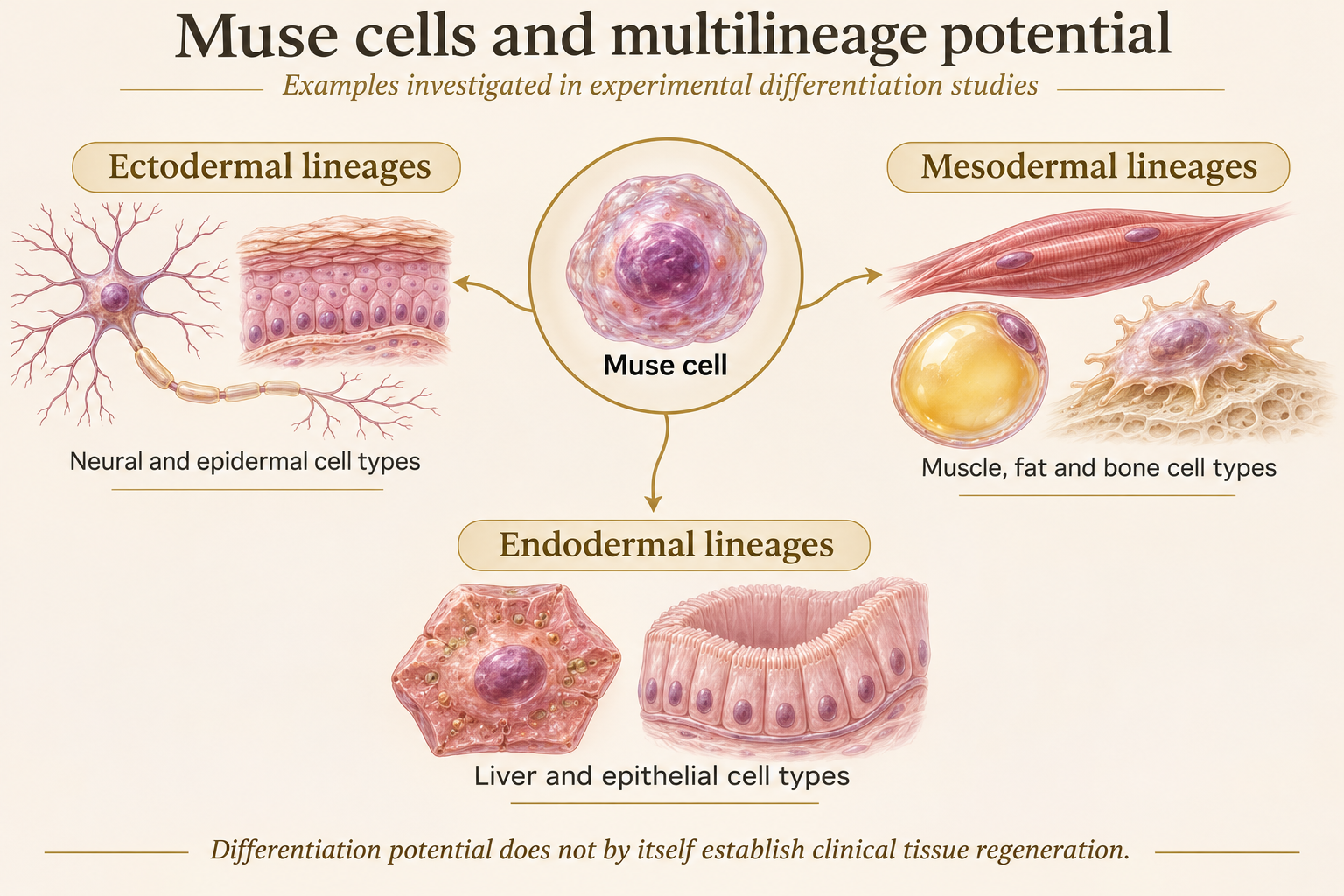
A central Muse cell branches to examples of ectodermal, mesodermal and endodermal cell types investigated in differentiation studies.
| Term | Scientific meaning |
|---|---|
| MSC population | A mesenchymal stromal population characterized by source, phenotype and function. |
| Muse population | A distinct population investigated using markers and functional properties described in Muse research. |
| Mixed tissue preparation | Multiple cell types obtained through a particular processing method. |
| Clinical trial product | A defined manufactured preparation tested under a specific protocol. |
Homing describes the preferential movement of cells toward a tissue environment. Yamada and colleagues studied Muse-cell behavior in a rabbit myocardial infarction model and implicated the sphingosine-1-phosphate/S1P receptor 2 pathway. Pharmacological and genetic interventions helped test the role of that signaling axis. Yamada et al. (2018). S1P–S1PR2 signaling and Muse-cell homing in a rabbit infarction model. Circulation Research.
This is a mechanism study: it helps explain how injury-related signals might influence cell localization. The value lies in a testable pathway, not in treating a diagram of homing as proof of universal clinical repair.
An observational human study also examined endogenous Muse-cell mobilization after myocardial infarction. Associations with later cardiac function supported further investigation, but observation of naturally circulating cells is different from testing an administered therapy. Tanaka et al. (2018). Endogenous Muse-cell mobilization after myocardial infarction. Circulation Journal.
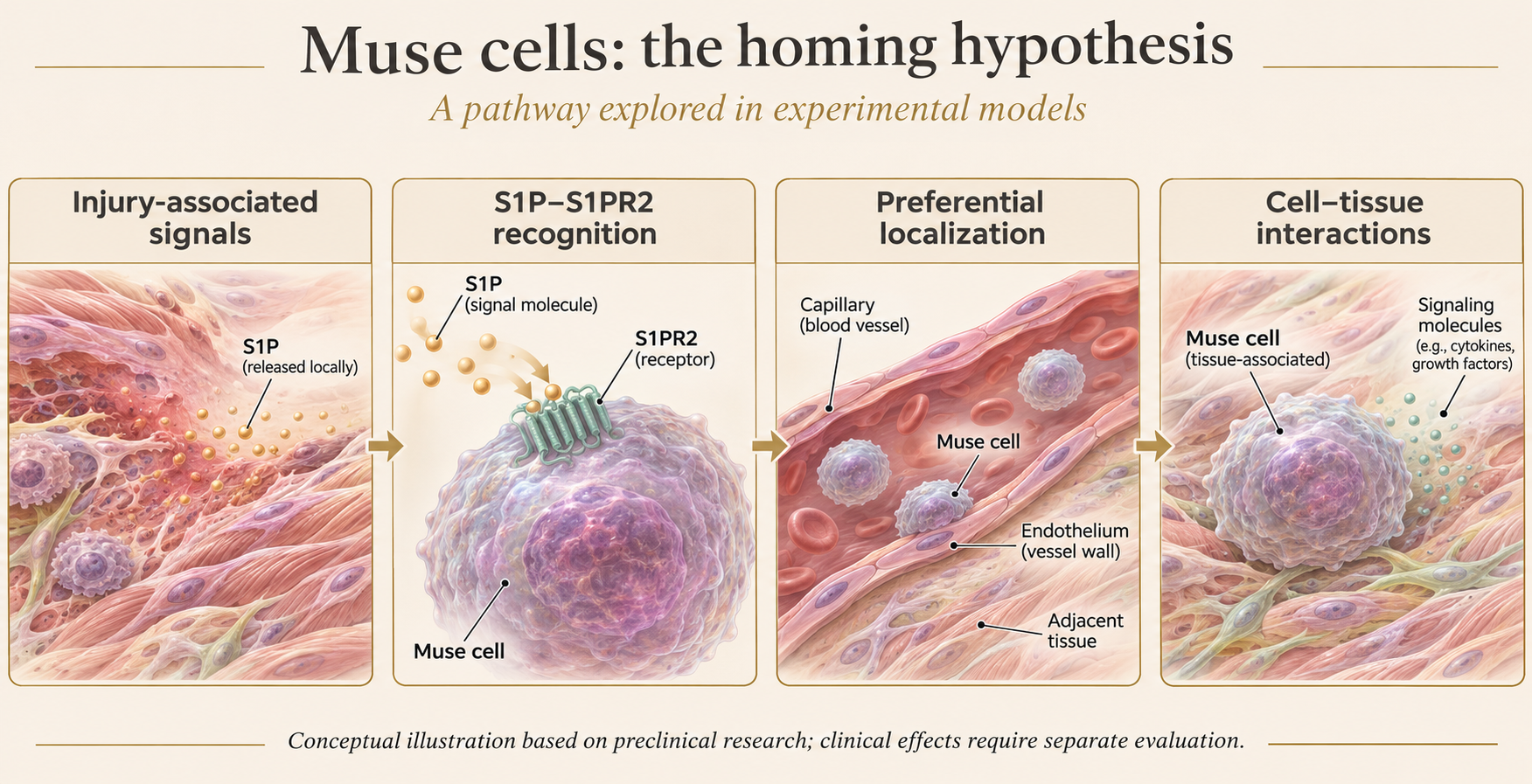
Four panels show injury-associated signals, S1P receptor recognition, preferential localization and cell–tissue interaction in experimental Muse-cell research.
The randomized CL2020 study enrolled 35 people with subacute ischemic stroke, treated 14–28 days after onset. Twenty-five received the donor-derived Muse-cell product and ten received placebo. At 12 weeks, 40% versus 10% reached a modified Rankin Scale score of 0–2. Confidence intervals were wide, and the prespecified efficacy threshold used registry data. One Grade 4 status epilepticus adverse reaction was reported. Randomized trial of CL2020 in subacute ischemic stroke
The result is encouraging because it concerns a meaningful human functional endpoint. The study is also small, and its product and treatment window are integral to the finding. CL2020 is discussed here as a research product, not identified as a product supplied by the clinic.
A strong clinical reading asks whether a later study confirms the signal, how participants were selected and whether the intervention being considered matches the evidence. Those questions help turn scientific interest into a focused consultation.
Mechanistic experiments can test whether disrupting a pathway changes cell behavior. Observational studies can examine whether naturally occurring cell responses are associated with recovery. Interventional trials can test the effect of administering a defined preparation. Each layer contributes different information.
In Muse research, the discovery work, homing experiments and early clinical studies form this progression. They should be read together without treating every stage as if it were a completed therapeutic trial. A laboratory differentiation finding, for example, cannot by itself establish a functional benefit in a person.
The next scientific questions concern reproducibility, dose and delivery, durability of response, and which clinical circumstances are most appropriate. A careful account makes those questions visible while giving promising human results the attention they deserve.
Muse research brings together several questions that are often separated: cell identity, stress response, localization after injury, differentiation and human functional outcomes. A convincing explanation follows those questions in order instead of beginning and ending with the label pluripotent.
For physicians, the next level of evaluation includes the actual preparation, delivery route, timing and patient population. For researchers, it includes reproducibility and the relationship between mechanistic experiments and clinical endpoints. For patients, it includes what meaningful progress could look like and how it would be assessed.
This is the deeper appeal of regenerative medicine: a cell population can generate new hypotheses about repair while clinical studies progressively define where those hypotheses may matter. The appropriate conclusion remains specific to the evidence rather than broader than it.
03 · Your practical guide
Sure Health 360 Center for Regenerative Medicine and Cell Therapy includes Muse-cell approaches within its cellular therapy discussions. The consultation should identify the exact proposed preparation and explain the evidence relevant to your condition and treatment setting.
Bring your diagnosis, recent reports, previous treatment history and current medicines. For neurological conditions, available imaging and rehabilitation assessments help establish a useful baseline. A family member can contribute observations about daily function with your agreement.
Before proceeding, understand the intended benefit, administration, practical requirements, relevant risks, alternatives and follow-up. A teleconsultation can begin this discussion before travel to Davao City. Appointments are confirmed by phone or email.
It explains the cell population and the CL2020 research. The stroke guide places cellular research within neurological recovery, rehabilitation and functional assessment.
Ask how the population is identified, which preparation is proposed, and how its clinical rationale relates to the research discussed.
A teleconsultation can begin the review of records and questions. The team confirms the appointment by phone or email.
Explore what this science could mean for you.
Bring your questions to Sure Health 360 Center for Regenerative Medicine and Cell Therapy. Consult in Davao City or begin with a teleconsultation. Appointments are confirmed by phone or email.
Request a consultationExplore all 14 services · Explore all care pathways · Meet your physician and clinic
The publications below report external research. They do not represent outcomes measured at our clinic.