
YOUR OWN BIOLOGICAL RESOURCES
Adipose tissue contains a cellular community with regenerative research potential.
SVF is a mixed cellular fraction obtained from adipose tissue. Its scientific interest lies in the interaction of several cell populations, making composition and processing central to understanding the procedure and its clinical research.
01 · Patient overview
Adipose tissue is more than an energy store. Alongside mature fat cells, it contains blood vessels, supporting cells and immune cells. SVF refers to a fraction obtained from this tissue that contains a mixture of cellular components.
An autologous SVF procedure uses tissue collected from the person receiving treatment. Unlike a culture-expanded MSC preparation, SVF is not a single selected cell population. Understanding this difference helps patients compare procedures intelligently and understand what a study actually tested.
02 · The science in depth
The IFATS/ISCT joint statement distinguishes freshly isolated SVF from culture-expanded adipose-derived stromal cells. SVF includes stromal, vascular-associated and blood-derived components, with composition affected by how the tissue is obtained and processed. Bourin et al. (2013). IFATS/ISCT statement distinguishing SVF and expanded adipose stromal cells. Cytotherapy.
This creates a different scientific question from studying an isolated cell type. Investigators must consider which populations are present, their proportions and their interactions. A total nucleated-cell count is not a stem-cell count, and a mixed preparation should not be described as a pure MSC product.
The distinction makes SVF scientifically interesting in its own right. The hypothesis concerns a cellular community and its activity within a tissue environment. Evidence about an expanded adipose MSC product cannot simply be relabeled as evidence about SVF.
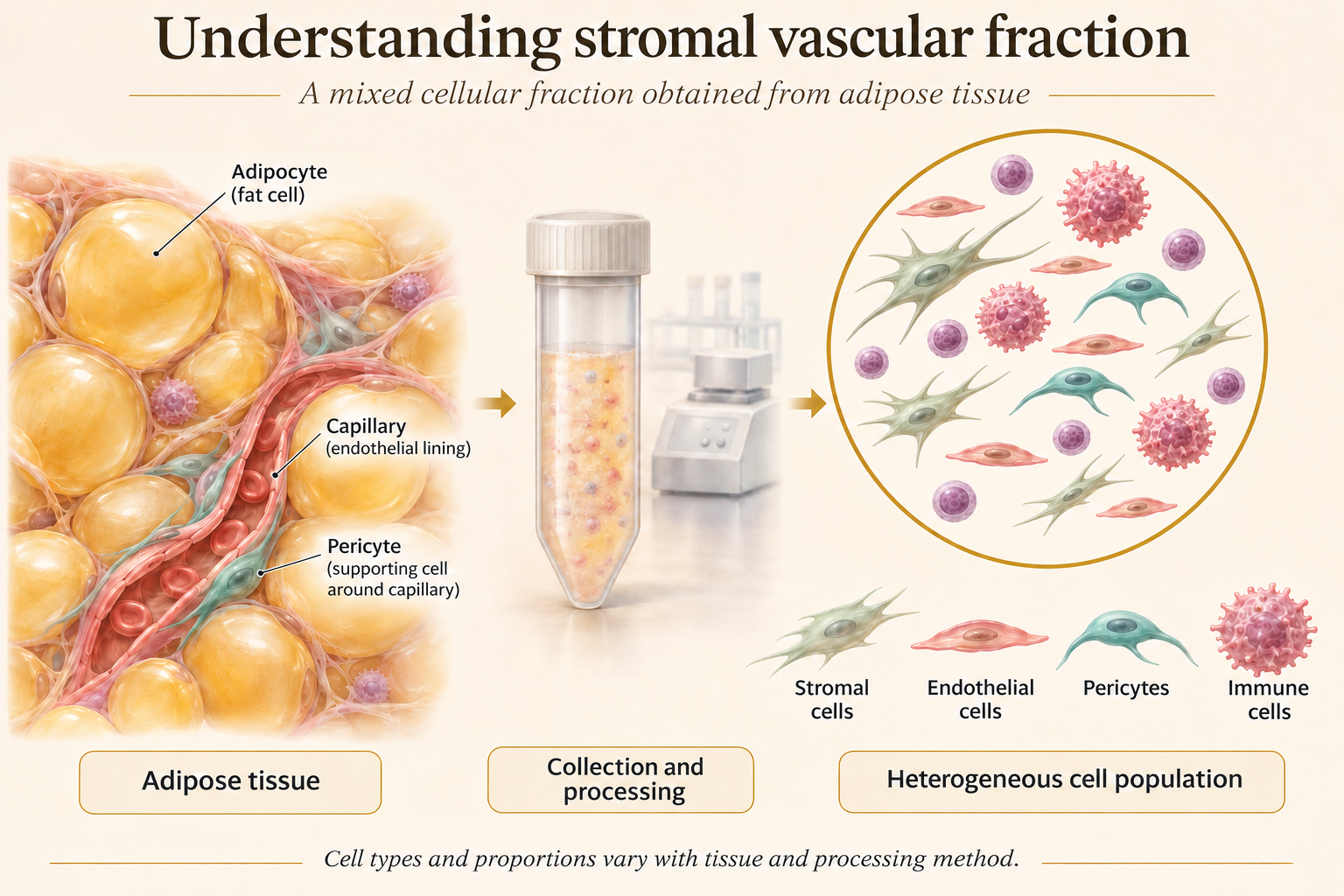
Adipose tissue, a processing symbol and a heterogeneous cell mixture, with a legend showing stromal cells, endothelial cells, pericytes and immune cells.
Two procedures may start with adipose tissue and produce substantially different material. A dissociated cellular fraction, mechanically processed tissue and a culture-expanded stromal population should be described according to what is actually produced.
The clinical explanation should identify the collection method, processing approach and final preparation. For a scientific reader, those details affect comparison with published work. For a patient, they clarify whether a proposed procedure resembles the intervention discussed in a research paper.
Autologous means the donor and recipient are the same person. It describes the source relationship, not a guarantee of clinical benefit or freedom from procedural risk. Tissue collection and administration both belong in the treatment discussion.
| Preparation | What distinguishes it |
|---|---|
| SVF | An adipose-derived mixed cellular fraction. |
| Expanded adipose MSCs | Cells selected and increased through a culture process. |
| BMAC | A concentrated bone marrow aspirate with a different cellular composition. |
| PRP | A platelet-enriched blood preparation, not a purified stem-cell population. |
A meaningful preparation record separates the amount of source tissue, the number of recovered nucleated cells and the number of viable cells. These quantities describe different stages of the process. None independently establishes the number of cells with a particular functional property.
Flow cytometry can help distinguish cellular populations through combinations of surface markers. The IFATS/ISCT statement provides a framework for reporting adipose-derived populations, which helps researchers compare material more accurately. Bourin et al. (2013). IFATS/ISCT statement distinguishing SVF and expanded adipose stromal cells. Cytotherapy.
For clinical interpretation, processing is therefore part of the intervention rather than a minor technical footnote. A publication should make clear what was administered. For the clinic’s own explanations, the corresponding details should come from the actual preparation documentation, not be borrowed from a different research protocol.
A randomized study of 66 participants compared SVF, rehabilitation and their combination. Sixty-two completed 12-month follow-up. The SVF groups had better reported pain and function outcomes than rehabilitation alone, providing an encouraging application-specific signal. Randomized study of SVF with and without rehabilitation in knee osteoarthritis
The larger MILES trial tested a different set of cellular preparations against corticosteroid injection and found no superiority for its tested SVF arm at one year. These studies use different comparators and protocols; the results should not be combined into a single success rate. MILES trial comparing cellular preparations with corticosteroid injection
The useful clinical question is therefore precise: which preparation, for which joint findings, compared with what alternative, and with which endpoint? The osteoarthritis guide develops the broader disease context and the distinction between symptom improvement and structural repair.
Pain and function are valuable outcomes. They should be measured in a way that distinguishes change from baseline from an advantage over a comparison treatment. Both can be informative, but they answer different questions.
Structural outcomes need their own measurements. An improvement in walking or pain does not automatically demonstrate new cartilage. Conversely, a small imaging change may not translate into an improvement a person can feel. A complete study discussion connects symptoms, function and structure without substituting one for another.
For a physician assessing SVF research, the preparation description is as important as the headline. Selection criteria, follow-up completeness and concurrent rehabilitation also influence interpretation. These details allow promising results to guide better decisions rather than becoming a generic claim about all adipose procedures.
03 · Your practical guide
Sure Health 360 Center for Regenerative Medicine and Cell Therapy offers SVF within its autologous biologic services. Assessment begins with the clinical problem, your treatment history and whether the proposed procedure has a coherent role in your care.
Bring relevant imaging, recent reports and a complete medication list, including supplements. Describe previous injections or procedures and the activities you want to improve. The physician will determine which additional assessment is needed; do not stop prescribed medicines without individualized advice.
The discussion should cover tissue collection, administration, recovery arrangements and the possibility of discomfort, bruising, bleeding or infection. It should also explain expected benefit, alternatives, costs and how progress would be reviewed. A clear plan lets you focus on the practical purpose of treatment.
For joint conditions, treatment planning should connect any biological intervention with appropriate movement, strength and rehabilitation. The goal is a coherent course of care rather than an isolated procedure.
A baseline might include pain during a named activity, walking tolerance and difficulty with stairs. Recording the same measures at follow-up makes progress easier to interpret. The clinical team can explain which measures and review intervals fit the plan.
Begin face-to-face in Davao City or with a teleconsultation. The team confirms appointments by phone or email and explains what information to prepare.
No. It is a mixed cellular fraction. Its composition and processing must be distinguished from an isolated or expanded cell product.
No. These preparations have different sources and compositions. Their clinical rationale and evidence should be explained individually.
No. The relevance of a study depends on the condition, preparation, delivery and outcomes investigated.
Explore what this science could mean for you.
Bring your questions to Sure Health 360 Center for Regenerative Medicine and Cell Therapy. Consult in Davao City or begin with a teleconsultation. Appointments are confirmed by phone or email.
Request a consultationExplore all 14 services · Explore all care pathways · Meet your physician and clinic
The publications below report external research. They do not represent outcomes measured at our clinic.